
Why do we help others? Dr. Natalie Buddiga studies the science
Psychology professor explores altruism and social decision-making while building an engaged classroom.
Dr. Natalie Buddiga, assistant professor of psychology, studies something most people encounter every day but may not think of as particularly scientific: why people help one another.
Her research brings together behavior analysis, social psychology and behavioral economics to examine altruism, cooperation and social decision-making – including how our environments and experiences influence the choices we make. That same curiosity shapes her classroom, where students might debate free will, work through research or recognize social psychology playing out in their own lives.
We caught up with Buddiga to talk about the science behind altruism, her approach to teaching, working with Salve students and the case she could make for fangirls (more on that later).
Q: What led you to psychology and eventually to Salve?
A: I did my undergraduate degree at Binghamton University in New York, where I became interested not just in psychology, but specifically in behavior analysis and behavior science. That brought me to the University of Nevada, Reno, where I completed my master's and Ph.D. in behavior analysis.
My research focused on variables that affect behaviors we consider altruistic and cooperative, so there was a melding of social psychology and behavior analysis.
During the last year of my Ph.D. program, I knew I was interested in academia and specifically teaching. Salve was looking for someone with this social psychology-behavior analysis hybrid, which I had never really seen before. My husband and I are both from New York and wanted to get back to the East Coast to be closer to family, so everything seemed like a good fit.
I graduated with my Ph.D. in May 2023 and started here that August.
Q: Were there signs growing up that research and teaching might eventually be your thing?
A: Looking back, definitely. I really liked reading and researching very specific topics that interested me. This is going to sound super nerdy, but in sixth grade, I wrote an essay about the Seven Wonders of the World because I became interested in the debate over what they actually were.
I would also make my younger sister read the books I was reading in English class and then make her take tests on them. Classic older sister stuff.
So the research and teaching interests were always there. Psychology came later, once I started taking courses as an undergraduate.
Q: Your research focuses on altruism and prosocial decision-making. What drew you to those questions?
A: When I went to graduate school, I was really interested in behavior analysis because of its scientific worldview – this idea that what we do is influenced by our environment and our experiences.
My advisor assigned me a first-year project on social discounting, which is essentially a quantitative way of describing altruistic choice, and it completely gripped me.
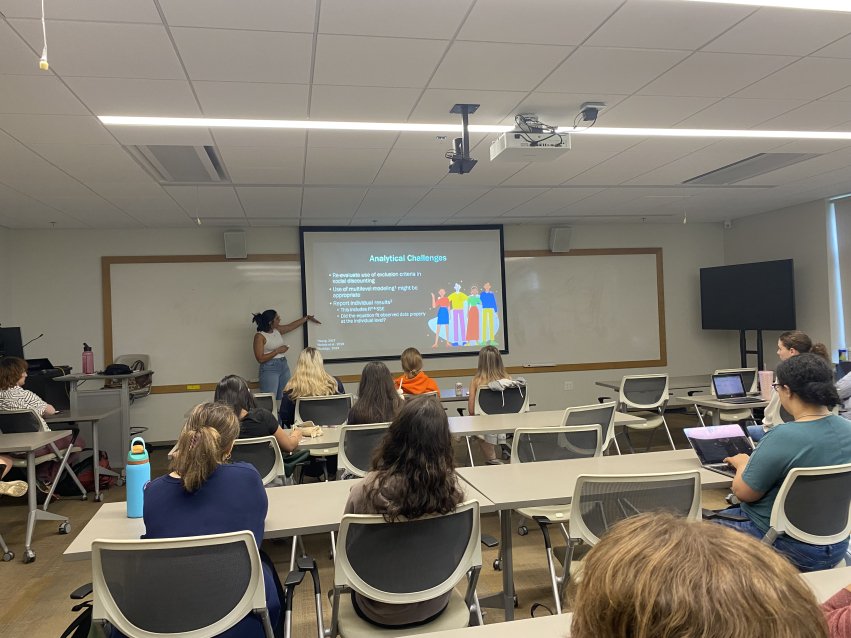
Altruism is often thought about as something inherent to a person – that you're born with this "goodness." I'm not here to dispute whether that's true, but people can forget that we can influence and increase prosocial choices if we evaluate the environment scientifically.
Something that can feel unscientific can actually be studied like other behaviors. We can ask what environmental variables influence it and potentially figure out how to promote more of it.
Q: What does studying altruism actually look like in a tangible way?
A: Right now, a lot of my experimental research uses hypothetical assessments. We might ask participants to make decisions between something for themselves and something for another person, then manipulate variables such as who the recipient is or how that person is described.
From that data, we can use quantitative models to describe the choices we're seeing and begin to understand what might be happening in the real world.
Part of my research is also questioning those methods themselves. Are our models actually doing a good job describing altruism? Are we studying this the right way? Altruism isn't easy to study, and that's part of what makes it interesting.
Q: How do Salve students become involved in your research?
A: I've been very fortunate to have stellar research assistants at Salve. The students care deeply and are incredibly committed to the work.
Generally, when students join my lab, they'll begin with a project that's already underway. They'll do a lot of reading and literature reviews and learn the scientific methods and quantitative concepts behind the research.
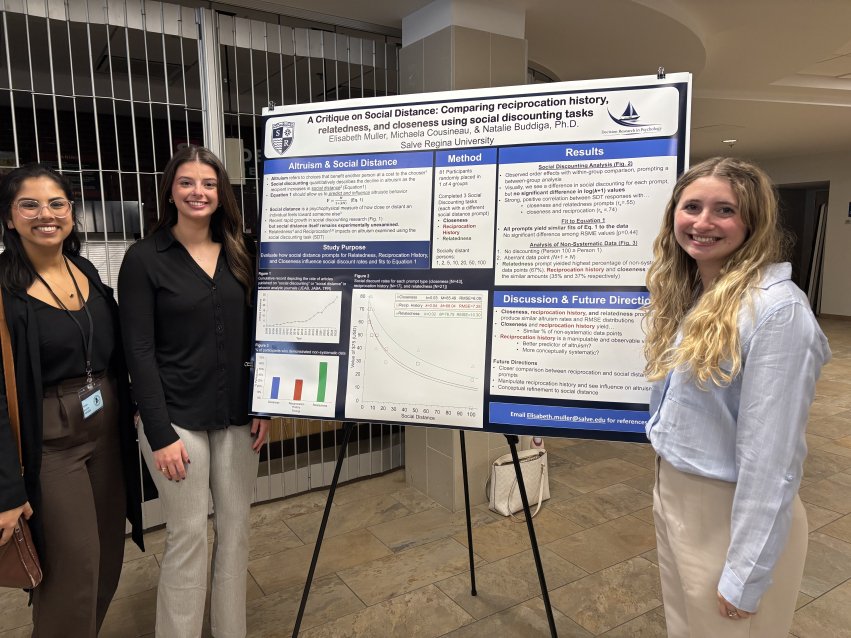
If a student demonstrates particularly strong theoretical, scientific and organizational skills, I might offer them the opportunity to develop an independent project. Then we work together to identify a question that's interesting to them and achievable during their time at Salve.
That's one of my favorite parts of the job. I can do all the research I want, but it's more fun to watch a student see their own project through from start to finish.
Q: You have said you enjoy teaching PSY250: Social Psychology. What do you like about it?
A: Social psychology is so relatable. We talk about group influence, peacemaking, aggression, intimacy and all these different forms of social influence and relationships that students encounter in their everyday lives.
One of the most rewarding parts is watching students make those connections. I'll have students come up to me and say, "Oh my gosh, the other day I experienced the spotlight effect," and I'm like, "Oh my gosh, same, bestie. I always think everything's about me, too."
I also get students from a lot of different disciplines – psychology, criminal justice, marketing, nursing and other areas. You end up with a diversity of perspectives in the classroom, which is really valuable.
Q: How would you describe your teaching style?
A: Engaged. That's probably the word I use most.
I try to bring a lot of energy into the classroom. I find that when I bring energy, students bring energy back.
In my upper-level courses, I also use a flipped-classroom format called interteaching. Students complete the reading before class and then they're randomly paired to work through it together. They tell me what they found difficult, and I use that feedback to build the next lecture.
I don't want class to be a passive experience. One of the most effective ways to learn is literally just talking to people about what you're reading and what you're confused about.
Q: What do you hope students remember after they've left your classroom?
A: I hope they remember the importance of community and making things personal.
I work really hard to learn everyone's name during the first couple of weeks. Sometimes I'll make them give me hints if I can't remember. But I commit to it because that's one of the joys of a smaller campus: You can interact with people in a much more individualized way.
When you make an interaction more personal, it's going to be more effective and meaningful for everyone involved. I hope students see that not only in my teaching but as something they can carry into their own lives.
Q: Outside of psychology, what's a topic you could give an entire lecture on?
A: The stigmatization of fangirls. Hear me out.
I'm very entrenched in pop culture, and I think when young girls really like something, their interests sometimes get devalued in a way that other interests don't.
If you have an 8-year-old who's really into a sports team, people tend to celebrate that. But if they're really into a pop group, it's treated differently. I think you can teach kids to have critical discourse about literally anything. Things associated with being hyperfeminine are sometimes devalued in a way that I don't think is fair.