A Wise way to solve medical mysteries
From pediatric brain cancer to COVID-19, students are using computational biology to uncover answers hidden in genetic data.
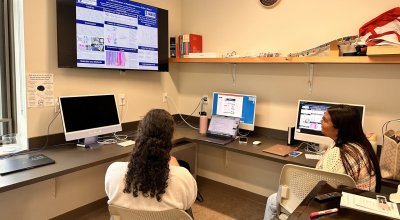
What can a blood sample reveal about a patient's cancer? Can genetic data help predict how severely someone will experience an illness? And how can researchers find meaningful answers hidden among hundreds of thousands of data points?
These are the kinds of questions driving research in the WiseLab at Salve, where students are using computational biology, machine learning and genetic analysis to investigate some of medicine's most complex challenges.
Led by Dr. Jillian Wise, assistant professor of biology and biomedical sciences, the lab works alongside researchers at Massachusetts General Hospital and Boston University to study everything from pediatric brain cancer to COVID-19. Students aren't just observing the process. They're analyzing real patient data, developing computational methods and presenting their findings to scientists across the country.
For Kenia Viri '27 and Calvin Dymond '26, that work has also opened doors to careers they hadn't imagined.
Finding answers in the data
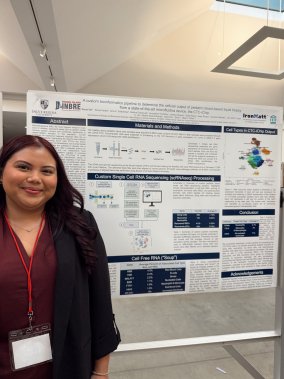
Nearly four years after joining the WiseLab through the Rhode Island IDeA Network of Biomedical Research Excellence (RI-INBRE) program, biochemistry major Viri is still investigating what causes some cancers to return after treatment.
Her research focuses on medulloblastoma, a pediatric brain cancer. Working with collaborators at Massachusetts General Hospital, the team is exploring whether rare cells circulating in the bloodstream could reveal information about cancer without requiring additional invasive procedures.
Using specialized technology and single-cell RNA sequencing, collaborators process blood samples before the WiseLab analyzes the resulting genetic data.
"We're able to analyze it computationally," Viri explained. "It takes a lot of work to annotate and decide what cells are which, and you don't want to get them wrong."
Viri is now testing how accurately existing computational tools identify rare cells, using datasets derived from 10 healthy pediatric blood samples.
"Sometimes these tools can tell us there are cancer cells present when there actually aren't any," Viri explained. "The goal is to improve the accuracy of these tools so researchers can more reliably identify rare cells that could provide clues about cancer."
For Viri, who originally planned to become a physician, the research has offered another way into the medical field.
"Even though I'm not working directly with patients, I know I am still making a difference in their lives," she shared. "So when the work gets difficult, it's easy to remember why I’m doing it."
From COVID-19 research to the professional lab
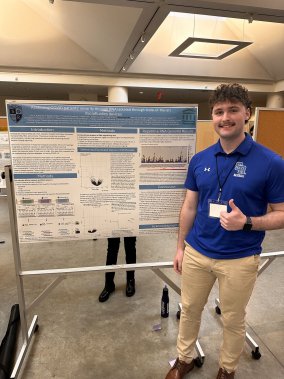
While Viri investigates pediatric cancer, Dymond's WiseLab research focused on why COVID-19 affects patients so differently.
A biology major with a chemistry minor, Dymond joined the lab without any computational biology experience. His work involved analyzing genetic data from patient blood samples to identify potential indicators of COVID-19 severity.
"We would take these massive datasets, sometimes hundreds of thousands of numbers, and we would be able to transform that into figures that actually explained what the different values meant," Dymond said.
The team identified two groups of genes associated with cell cycle and DNA repair that showed increased activity in patients with more severe illness.
Today, Dymond is continuing that work as a research engineer in Dr. Shannon Stott's laboratory at Massachusetts General Hospital. The opportunity emerged after he met Stott, a WiseLab research collaborator, during a conference at Harvard University.
He's now working on projects involving long COVID-19 and several forms of cancer, gaining hands-on laboratory experience while continuing to collaborate with Salve researchers to publish his WiseLab work.
Taking their research to the national stage
Both Viri and Dymond presented at Harvard University's National Collegiate Research Conference (NCRC), exchanging ideas with undergraduate researchers from across the country.
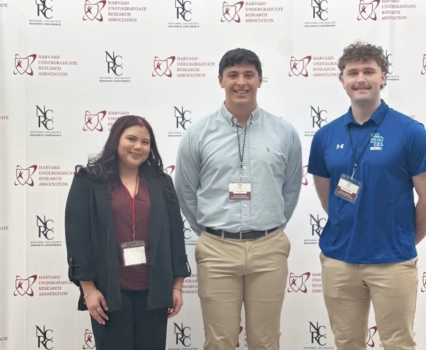
"A lot of the questions I received were very thought-provoking," Dymond said. "You really had to understand the biology and the reasoning behind our methods well." The conversations challenged him to think more deeply about the research, particularly the laboratory techniques behind the data he had spent so much time analyzing.
Viri went on to present at the New England Computational Biology Conference this October, sharing her findings with graduate students, doctoral candidates and established researchers. The experience challenged her to communicate complex research to a professional audience and helped solidify her plans to pursue a Ph.D. in computational biology.
"Going to conferences really helps you see that you're building your foundation in college," Viri said. "It's exciting to hear people already in their careers talking about tools that we're using and things that I know. It shows there's so much more that can be done, and that I’m actually contributing to the field."
Beyond the conferences, both researchers credit Wise's mentorship and their undergraduate experiences with preparing them to take those next steps.
"It makes it seem so attainable," Viri said. "I'm presenting at the same conference as people getting their Ph.D.'s and master's. It makes me feel like I can do this."
From investigating complex medical questions to presenting alongside experienced scientists, the WiseLab is giving students opportunities to contribute to research with real-world implications.
For Viri and Dymond, these experiences helped turn an interest in science into a future in the field.