"You can be Hawaiian anywhere"
Claire Māhealani Dunn '28 shares her heritage and what it was like to showcase it with the Maui Public Art Corps.
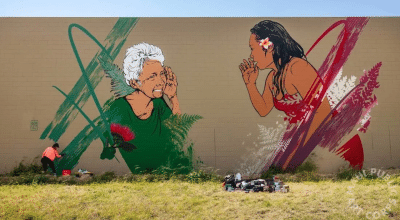
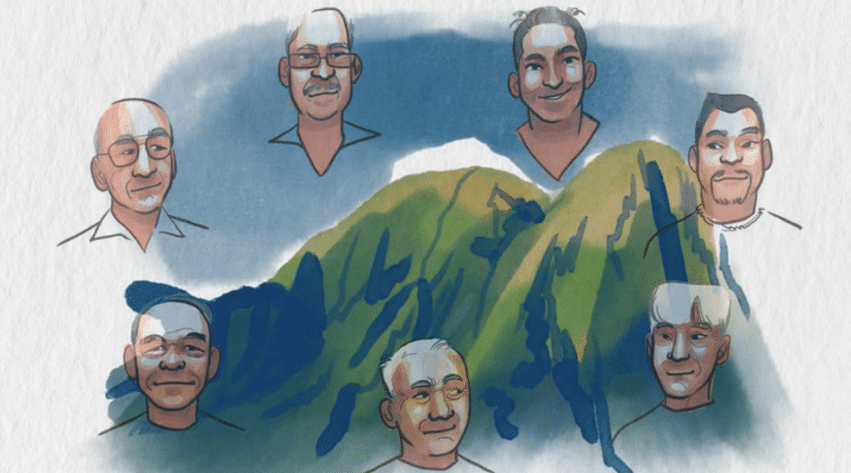
Artwork from the Kahului Mural Project, inspired by the stories of Nanifay Paglinawan and Pualani Enos.
By student writer Ava Ayotte '27
For Claire Māhealani Dunn '28, art and dance are more than creative outlets. They are ways to preserve her Hawaiian heritage, honor her ancestors and share stories that might otherwise be lost.
On Sept. 18, the studio art major and dance minor brought that passion to New York City, participating in a showcase at NYU and The Museum of Modern Art (MoMA) featuring artwork inspired by the stories and experiences of Hawaiian communities.
The showcase highlighted the work of Maui Public Art Corps, an organization that transforms interviews with community members and elders into murals, animations and other works of art that preserve and celebrate Hawaiian culture. Dunn joined a cohort of Hawaii-born college students studying on the East Coast to interview community members, helping bring their stories to life through art.
Their work also connects to an ongoing effort to create a memorial in Lāhainā, the historic Maui town devastated by wildfires in August 2023. Through conversations with residents and cultural practitioners, the project explores how art and storytelling can honor those lost, preserve the town's history and help the community heal.
For Dunn, whose family has long been involved in Hawaiian cultural preservation, the experience was both deeply personal and an opportunity to apply what she has learned at Salve on a larger stage.
Q: How did you become involved with Maui Public Art Corps, and what was your role in the project?
A: My mom did a few cohorts earlier in her life where she did interviews that were turned into murals and animations. I wouldn't really know about the cohort if it weren't for my mom.
My role, along with a few other East Coast college students from Hawaii, was to conduct interviews with elders and community members that were later turned into art pieces. There are animators, musicians and artists from different mediums across the globe who are working with these stories.
As an artist and dancer, seeing how my family has done this firsthand, I've been able to put our ideas and stories at the forefront of this beautiful memorial.
Q: How does this project help preserve Lāhainā's history and support the community following the 2023 wildfires?
A: We're trying to talk to different councilmen, elders and people in the community to understand what would be best suited for a memorial in that area. There's been a huge debate between the fact that it was a historical town versus a tourist town.
We talked to people from the 9/11 Memorial & Museum about ways we could build the memorial. They're still working through that process of grief, and for people of Hawaii, we're asking: What are our next steps? How do we, as a community and as an island, come forward?
Q: What was it like sharing these stories and your Hawaiian heritage at MoMA?
A: It was a true blessing to do it alongside family members. The fact that my heritage and lineage have been doing this for decades, and now I'm able to use my strengths and passions to show my heritage in a unique way, is really special.
To be able to say that I got to represent my hometown and my culture at such a high-statured, world-class museum was a really big moment. Not just for me, but for all of us. My mom, my aunts and people in my hula academy who have raised me since I was a baby were all represented in these murals and presentations.
Q: How has growing up immersed in Hawaiian culture influenced your approach to art and dance?
A: When I dance or do any of my artwork, it's for all of us. It's for the ancestors of the past, present and future.
Hula is what we use for historical documentation. Instead of words and writing, our marine biology, sciences and history were told through stories and mythology. Instruments and dancers created that storytelling. Everything I know and have documented historically has been through art and movement. That's really what sparked my drive.
For me, it's more of a way of feeling seen and helping others so they don't feel alone. It's also very spiritual for me.
Q: How have your studio art major and dance minor at Salve prepared you for opportunities like this?
A: My professors have really prepared me to think more critically and hone my ideas about art. Lindsay Guarino [chair of the music, theatre and dance department] and I have had conversations about how jazz has been appropriated over the years and how movement is a way of expressing freedom, individuality and spirituality.
Ernest Jolicoeur [chair of the art department] has pushed me to think more critically, and Dr. Tara Brooke Watkins' [assistant professor of theatre] course on community engagement and theater showed me how interviews, discussions and art can create safe spaces for people to use their voices and heal.
The more we pour into Salve, the more Salve pours into us. These professors have helped me see that what I once thought were just hobbies could become something much bigger.
Q: How do your studies complement each other, and how do you incorporate your Hawaiian culture into your work at Salve?
A: As someone who plans to somehow use my major and minor to preserve cultures through art and movement as a painter, as a dancer and as a Hawaiian, I've been able to put these ideas, my lineage, my tutelage and my ancestral knowledge into a medium that is tangible.
Q: What did participating in the showcase teach you about yourself, your culture and your artistic abilities?
A: It taught me that you can be Hawaiian anywhere. I'm always representing Hawaii, no matter where I am. The showcase showed me that I really can do this. I have the tools, I can do the networking, I can talk to people with different backgrounds. As someone who plans to use my major and minor to preserve cultures through art and movement, I'm starting to see how I can bring my heritage, my love for art and my education together. It was a real turning point for me. It showed me that all of the things I want to do can be done.
Q: As you continue at Salve, how do you hope to bring your culture into your future artwork and performances?
A: At Salve, I'm asking more questions about how things are critically aligned with anthropology. I'm looking at anthropological backgrounds, cultural backgrounds, practitioner backgrounds and how I can use these things at the forefront of my work. Next semester, I hope to study abroad in New Zealand at the University of Otago. Their mission focuses on indigenous leadership and hemisphere and Pacific thought.