

Faculty Fellow Spotlight: Dr. Luigi Bradizza
Dr. Luigi Bradizza, a professor of political philosophy and American government at Salve Regina University, encourages students to understand the roots of American politics, engage in meaningful critical thinking and examine both the benefits and pitfalls of modernity.
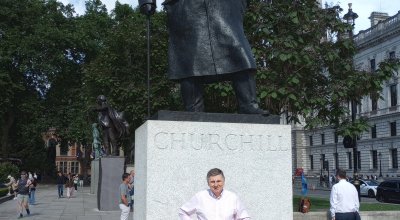
As a professor of political science at Salve Regina University since 2009, Dr. Luigi Bradizza has spent his career examining the ideas and institutions that shape political life. His teaching and scholarship span political philosophy, American politics and legal history. In this Faculty Fellow Spotlight, Bradizza reflects on the book that first sparked his interest in politics, the importance of critical thinking, the tensions of modernity and why intellectual humility remains essential.
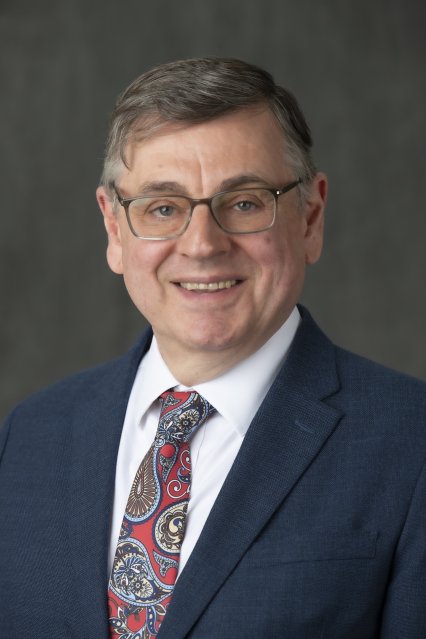
Q: What are your areas of expertise, and what initially sparked your interest in those fields?
My two areas of specialization are political philosophy and American politics, and I teach both areas. I teach classical and modern political philosophy, and next fall I'll also teach a medieval political philosophy course. My political philosophy courses are cross-listed between political science and philosophy and can satisfy a core requirement, so we get students from every discipline. In American politics, I teach courses on American political thought, Congress, the presidency, and law-related courses for our pre-law students, where we look at actual Supreme Court cases and American legal history.
My initial interest in these topics was sparked when I was 14 years old. An English teacher recommended The Rise and Fall of the Third Reich by William Shirer. It was 1,599 pages, and it took me the whole term to read it. My mind was opened to this epic drama that spanned the 19th century, through World War I, the interwar period, and World War II. Reading it was like growing up in a small room only to realize the door opens into a world a thousand times bigger than you'd imagined.
Over time, I decided on American politics and political philosophy because they're complementary subjects. It makes no sense to study American politics without understanding its roots. We can learn how a bill becomes law and how the branches of government work, but thoughtful people eventually ask: Why does it have to be this way? Is it good or bad? What justifies it? Those questions lead you into political philosophy.
Q: What skills and insights do you hope students develop through your courses?
Critical thinking.
If you have a four-year degree and you're not one of the elites, the way to defend yourself from political manipulation is by understanding what's going on around you, analyzing it to the best of your abilities, and practicing critical thinking.
At every turn, someone is trying to persuade you, change your mind, or keep your attention. They're not interested in presenting both sides of the argument any more than a salesman is interested in giving you a full accounting of a product's defects. They'll give you all the positives. For the negatives, you're on your own.
You need to recognize that there are people who want to run your life, and you need to defend yourself through careful analytic probing and critical thinking. It can be exhausting, but it's important.
Q: What questions or topics in your field are keeping you curious right now?
The deepest question I want to probe right now is the character and nature of the modern world.
What do we mean by modernity? There are many theories, but the short version is that it starts about 500 years ago as a political and scientific project. It has produced tremendous benefits for humanity. Modern medicine, communication, transportation, and technology in general have improved human life enormously.
In a certain sense, the modern world has made us more human. But at the same time, some of the methods we use to understand the world can, when turned toward understanding human beings themselves, become dehumanizing. A scientific understanding works with what is measurable. Yet aspects of human life like faith, reason, and morality are not fully measurable. Values are therefore not scientifically discernible. Yet human beings cannot live fully human lives without values.
What fascinates me is this tension. Modernity has produced tremendous advances, but it has also created forms of moral self-doubt and dehumanization. Understanding both the strengths and weaknesses of the modern project is one of the most important questions we can ask.
The ideal is to retain a graduate student's curiosity about the world and enthusiasm for new ideas throughout your life.
Q: Is there a book, article, podcast, idea, or other piece of media you've encountered recently that you'd recommend?
I'd recommend a moderate, sober, intelligent voice: the podcast Triggernometry.
It's hosted by two English gentlemen, neither of whom is an ideologue, and they host guests from across the political spectrum. They have changed their minds based on conversations they've had, and they hold some views that are more left-wing and some that are more right-wing. The hosts model reasoned discourse, and that's the kind of conversation people should be having in their private lives.
It’s important to have a little humility and self-doubt. Be curious when someone believes the opposite of what you believe. What is it about their views that persuades them? You might find that some of what they're saying is true.
As people get older, they tend to become more certain of their views. But certainty can be a trap. As you feel age giving you greater confidence, perhaps you should ask whether it's a gift or a curse. Maybe you're becoming set in your ways.
The ideal is to retain a graduate student's curiosity about the world and enthusiasm for new ideas throughout your life.