
Sláinte to the next generation of caregivers!
Salve students traveled to Limerick, Ireland to explore public health systems, returning better prepared to care for diverse populations.
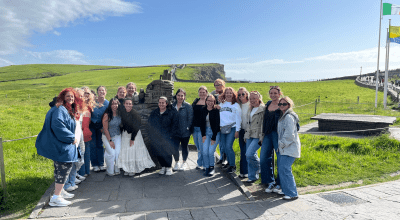
For many nursing majors, studying abroad can feel nearly impossible to fit into an already rigorous academic schedule filled with required courses, clinical placements and preparation for licensure. But through Salve Regina University's short-term public health study abroad program in Ireland, students in nursing, social work and related healthcare fields are able to gain an international experience that connects directly to their future professions.
Led by Dr. Debra Cherubini, associate professor of nursing, and Dr. Mary Montminy-Danna, professor and chair of the social work department, the course begins during the spring semester at Salve before continuing for two weeks in Limerick, Ireland, where students study at Mary Immaculate College and engage with healthcare providers, nonprofit organizations and community resources.
"This international public health course affords the students an opportunity to see various vulnerable populations and resources that are provided up close," said Cherubini. "The course allows the students to compare and contrast resources and vulnerable populations in the United States versus the same populations and similar resources in Ireland."
For Grace Langa '27, a nursing major from Franklin, Massachusetts, the program offered something rare: a study abroad opportunity that not only fit into her nursing plan, but also fulfilled a required public health course.
"This is the only opportunity nursing majors get to study abroad that will correlate directly to our major," Langa said. "We could do the short-term study abroad programs that complete a gen ed requirement, but none of those contributes to our nursing degree."
During the spring semester, students met at Salve for guest lectures, discussions and reflection assignments focused on public health, disaster preparedness, community nursing, homelessness, immigration, autism resources and local care systems. Once in Ireland, they continued those conversations through lectures at Mary Immaculate College and visits to organizations supporting vulnerable populations throughout Limerick.
For Langa, the structure of the course made the learning especially meaningful. Students kept journals throughout the semester and abroad, responding to prompts and reflecting on what they learned from each speaker and site visit.
"As much as you can go back and look at pictures, it's really the information that you learn and what is said that'll stick with you," she shared.
The course challenged students to look closely at how healthcare and public health services differ between Ireland and the United States. Langa was surprised to learn more about Ireland's healthcare system, including the role of private insurance and waiting lists, but she was also struck by the country's wide range of community-based resources.
"They have free healthcare, but they also utilize a waiting list. However, people who buy private insurance get put to the top of the waiting list, and they'll get seen before anyone else, like those who cannot afford private insurance," said Langa. "It doesn't matter the procedure or anything like that, as long as they have health insurance and they bought it, then they'll get shot to the top of the waiting list."
She added, "What I think they lack in healthcare though, Ireland kind of makes up for it with their community resources. They had a lot of free resources for children with disabilities, families who had single parents, who were teen parents. There's a lot of extra community resources that were free that we don't have here."
One of the most impactful visits for Langa was to a respite care center for children with disabilities, where students learned how the program provides care for children while giving parents and caregivers time to rest. The group also visited a school for children with disabilities, where they observed how physical spaces, classroom structures and medical supports are designed to meet students' needs.
"The whole purpose of it is to give the parents a break, and to give the caregivers a break," Langa said. "Caring for someone with a disability, such as cerebral palsy or muscular dystrophy, even forms of autism, it is really demanding."
Payton Shepard '28, a nursing major from Dighton, Massachusetts, was also struck by the range of specialized organizations students visited, including programs focused on homelessness, autism, grief, mental health, addiction support and families affected by incarceration.
"I think it gave me a broader perspective and kind of opened my eyes," Shepard said. "I think it's also important because we talked about health and equity, and making sure that everyone's treated the same across the board."
For both students, the course reinforced the importance of advocacy, cultural awareness and understanding the resources available to patients beyond a hospital or clinical setting. Shepard said the experience will shape the kind of nurse she hopes to become.
"I'm going to try to be a nurse who advocates for their patients, making sure that they fully understand what's going on and feel safe," she said. "If they don't feel safe or like they can trust you, then you're not really going to be as helpful."
For Langa, the program opened a new professional interest she had not expected. Before traveling to Ireland, she said she had not learned much about public health. After the course, she began considering how public health could become part of her future.
"This trip has made me want to become more interested in public health nursing, because we have so much left to do," Langa said. "I can honestly say that I'd be interested in going back to school and getting my master's in public health and learning more about it, because it's something that I'm actually interested in, and this trip definitely was able to show me."
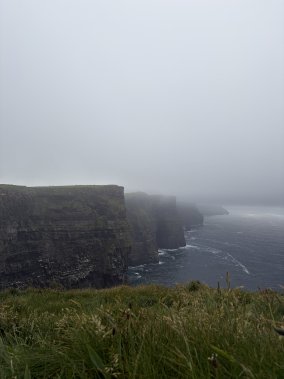
Outside the classroom, students also experienced Irish culture through excursions to downtown Limerick, the Cliffs of Moher, Bunratty Castle and Dublin. They stayed in residence halls at Mary Immaculate College, built friendships across class years and gained confidence navigating a new country.
For Langa, those relationships were one of the unexpected highlights. As the incoming president of Salve's Student Nursing Organization, she appreciated the chance to connect with younger nursing students in a way she might not have otherwise.
"Sometimes I feel like even though we're in the same major, we're so divided, just because we're in different classes and we're different ages," Langa said. "It just built more connection."
Shepard agreed, saying the program offered both academic and personal growth.
"You should see different cultures," Shepard emphasized. "Even working in the States, there are going to be people who have different cultures or rituals, and you have to be able to help them and communicate properly."
For students preparing to enter nursing, social work and other helping professions, the study abroad program in Ireland offers more than a chance to travel. It provides a broader understanding of how communities care for vulnerable populations, how policy shapes access to care and how public health systems can support individuals and families in different ways.
As Cherubini explained, the lessons students bring home can help them think more deeply about the kind of care they want to provide.
"The information that they gain can help them to develop and consider interventions for vulnerable populations that will correct or ameliorate the vulnerability of a population," Cherubini said.
For Langa, that is exactly what made the experience so valuable.
"Making sure that we have awareness of not only healthcare in the United States, but also healthcare in other places as well, it really will help me in the way that I treat all patients," she said.