Salve students gain industry experience at Newport Folk and Jazz festivals
With the City of Newport's deep connections to the music industry, Salve music students have access to unique opportunities and a creative community right outside the campus gates.
For more than 70 years, Newport has held a distinctive place in American music history. The Newport Jazz Festival, founded in 1954, helped establish the model for the modern music festival, while the Newport Folk Festival, founded five years later, became the setting for performances and moments that helped shape American music and culture.
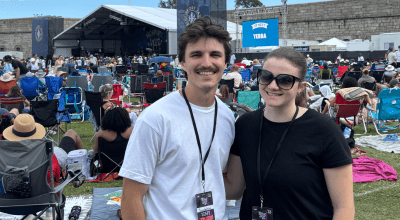
This summer, Grace Kasten '27 and Topher Weber '27 experienced that history from behind the scenes as interns with Newport Festivals Foundation. From stage production and artist support to music education and community programming, their roles offered two very different looks at the work that makes the Newport Folk and Jazz festivals – and the Foundation's year-round mission – possible.
They found themselves working just feet from major artists, including Hayley Williams, Herbie Hancock and Sullivan Fortner. But the bigger takeaway was everything happening around the performances: the technical crews, educators, nonprofit professionals and production teams that showed them just how many ways there are to build a career in music.
Learning what happens before the music starts
Kasten is a music major with minors in communications and women, gender and sexuality studies.
"I see myself with a future in vocal performance," she said. "But I think it's incredibly important to make sure that I know what's going on backstage so that I can get onstage."
After applying for a stagehand internship the previous summer, Kasten tried again and earned the role – at both Folk and Jazz Fest. Assigned to the Fort Stage (the biggest at the festival), she arrived at 6 a.m. to unload trucks, build and move risers, set up instruments and equipment, patch audio and prepare the stage before festivalgoers arrived.
The work gave her a professional-scale version of skills she had begun developing at Salve, where music students learn to set up equipment and prepare their own performances. She learned more about audio patching, instrument setup and even the proper way to coil cables.
"I learned so many tangible skills, but it was just the overall understanding of how many people and how many brains and how much work goes into just one performance that made all the difference for me," she said.
There were memorable perks, too. Kasten worked within feet of artists including Hayley Williams, Lizzy McAlpine and Brandi Carlile and helped load Herbie Hancock's piano after his Jazz Festival performance.
Between the two festivals, she also worked as a counselor for the Newport Jazz Summer Camp at Salve, supporting high school musicians who ultimately performed at Jazz Fest. On some days, she started the morning as a stagehand and switched into camp counselor mode in the afternoon.
Together, those experiences gave Kasten a broader understanding of the field she hopes to enter – from preparing a stage to supporting young musicians to seeing a major festival operate in real time.
Discovering careers beyond performance
Weber, an American history major with minors in music and secondary education, took a different path into the Foundation. He arrived at Salve planning to study history and education, but gradually became immersed in the University's music community, playing bass – and sometimes keyboard and guitar – with Salve students and alumni and performing locally with bands including Dabble and The Grafters.
This summer, he worked with both Newport Festivals Foundation and Newport Classical, experiences that helped clarify how music could fit into his career.
His Foundation internship centered largely on its year-round music education work. He sat in on songwriting and jazz programs, offered feedback to students, moved equipment and helped facilitate community performances, including an event for kids at Camp Grosvenor with the Boys and Girls Club of Newport County.
For Weber, who didn't have a strong music program available to him in high school, that work was particularly meaningful. He became as interested in the Foundation's smaller education programs as he was in its internationally known festivals.
"The festivals are super alluring because they're grand and noisy, and it reaches the whole country," he said. "What's really interesting is the little underground events that are happening throughout Rhode Island – the little music education events that make these huge impacts."
During the festivals, Weber worked in the Foundation tent, supported membership efforts and helped facilitate artist appearances. At Jazz Fest, he escorted acclaimed pianist Sullivan Fortner and spent time around his production team. Instead of focusing only on the artist, Weber found himself noticing the professionals around him and the distinct roles each played.
"That was really the biggest learning moment – seeing all the full-time roles that exist within music," he said.
For someone who had questioned whether a career in music could be practical, that exposure changed his perspective.
"It was really amazing to see that there's this lovely middle ground where music can be stable, and there are so many career paths within that," Weber said.
Connecting through the Newport community
For both students, the internships also demonstrate the value of studying music in Newport. The city's arts organizations, venues and festivals give students opportunities to connect what they learn at Salve with the professional creative communities surrounding the campus.
Kasten saw professors and musicians she knew through Salve working within the festival world. Weber spent his summer in Newport moving between the Foundation, Newport Classical, local performances and community programs, building relationships with musicians, educators and nonprofit professionals along the way.
"We have a beautiful campus. It's lovely," Weber said. "But get off campus. Go interact with the community. Explore the state. Go up to Providence. Go join a nonprofit or volunteer. We are located in a place that allows you to get involved in so many different things in so many different places."
That experience helped Weber see a clearer path for after graduation and gave Kasten a more complete understanding of the industry she hopes to enter as a performer.
"It was heartwarming to see that there's also a community in music that's not necessarily on the performance level," Kasten said. "It reminded me of how many different aspects and how many different worlds go into one big performance. It made me really appreciate the space I want to enter one day even more."
For Weber, that is the value of getting professional experience while still in college: students can test their interests, discover roles they didn't know existed and apply what they have learned in a setting where the work is real.
"I think it's crucial to any higher education institution to not only get you the job you want at the end of your four years, but to challenge what you think you want throughout the way by giving you meaningful experiences that help you figure it out," he said.