Students create "pure joy" through jazz dance in Newport
What it's like to perform with professional musicians at the Newport Jazz Festival and a jazz lounge in a Gilded Age mansion.
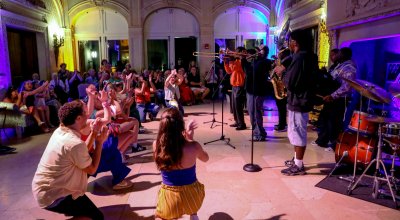
The dance program at Salve Regina University offers a unique focus on jazz studies. Being located on hallowed jazz ground, the site of the world-renowned annual Newport Jazz Festival, creates opportunities for students to experience the form in unique ways.
July 23-Aug. 3, Salve hosted the third annual Bridging the Gap jazz dance and music festival, which included "Roots and Revelry," a jazz lounge event at Salve's Ochre Court. There, the ocean-front mansion transformed into an immersive club featuring Providence, RI-based Marcus Grant and the Movement and the Trombone Shorty Foundation Alumni Band from New Orleans, with the music made visual by One Jazz Collective – a group of dancers and scholars that included Salve dance students and alumni.
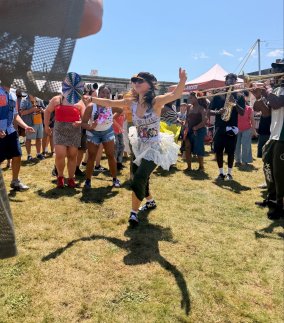
On July 31 and Aug. 1, the dancers joined the Trombone Shorty Foundation Alumni Band on Jazz Festival grounds at Fort Adams in a second line – a tradition of New Orleans where a brass band and main organizers lead and the crowd of revelers follow.
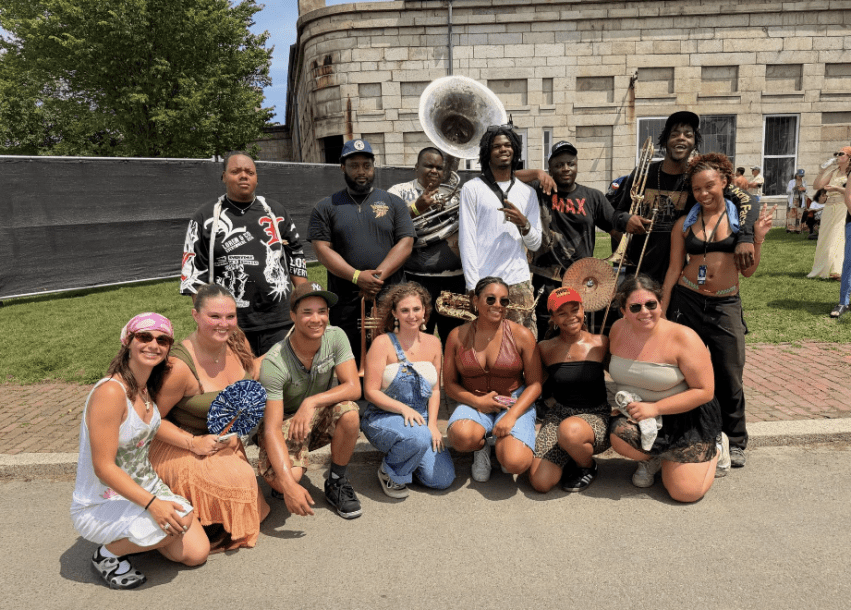
Angel Ahern '27, Chelsey Ghareeb '27 and Cc Smith '27, three of the Salve dance students who performed at both venues, shared thoughts and photos from the experiences.
Chelsey Ghareeb '27
Ghareeb is a dance major with a concentration in choreography and performance and minors in sports management and communications.
Q: How did it feel to perform at the Newport Jazz Festival?
A: Getting the opportunity to perform at the Newport Jazz Festival was one of the best moments of my life. Being able to dance to live music is always such a rewarding feeling. Being part of a second line was so unique to me because while I was dancing, I got to witness people's pure joy while weaving our way through the crowd.
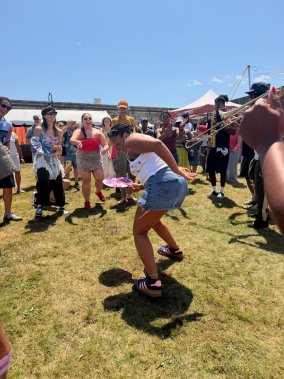
The festival always has such a positive impact on me, but after performing, I loved knowing how much of an impact we all made on people's days. I took away that simply dancing in community is the best form of medicine for me and for others.
Q: Why is it important to bring jazz dance and music together?
A: They are both such a sacred thing, and a shared language. Jazz was born from resilience, pushback and pain, but also from joy, community, freedom and perseverance. Dance is such an expressive art where you are free to express yourself.
Jazz music can be such a liberating sound that you just have to dance to it. Jazz and social dances are also tied culturally to Black American history, so it's more about honoring where it started. Putting these art forms together honors the history and deep roots of where they both came from. Personally, when I hear any music, I have to start moving and grooving!
Angel Ahern '27
Ahern is a dance major with a concentration in performance and choreography.
Q: How much rehearsal did you do with the live musicians before the jazz lounge and festival?
A: For the jazz lounge, the one piece we knew in advance was "Tutti Ma" which was created for a previous jazz lounge by Trinity Leite '25. We reviewed that piece ahead of time on our own but learned all other newer pieces either the week or day before the event.
On the day of the jazz lounge, Marcus Grant worked with the musicians practicing the tunes together for the first time. We as dancers also rehearse with the band for the first time that day. Since "Tutti Ma" was a returning piece, we didn't even rehearse with the band once and instead figured it out live when Marcus played it during the lounge! Performing "Tutti Ma" this time was completely different from the last time. I had the opportunity to perform pieces with Marcus' group as well as the Trombone Shorty Foundation Alumni Band. Our choreographers worked with each group to make sure we were all on the same page and understood the form and organization of each tune.
It has become clear to me how important it is for dancers to understand the musical terms to communicate clearly when working with live musicians. As students, we had the opportunity to learn from Marcus Grant as he taught courses at Salve. Having a mutual understanding between dancers and musicians and a shared language makes moments like preparing for a jazz lounge day of run smoother and quicker. Since we were all able to understand one another to some degree, we were able to find common ground and feel prepared for the live performance later on.
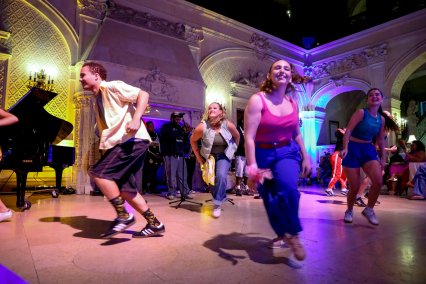
As dancers, when we learn these pieces, we learn the choreography to pre-recorded tracks from different artists so when we hear the band play the tune for the first time, it usually sounds different. We discuss how to collaborate and what cues we need to know when to begin different sections, and what you see at the jazz lounge is the result. Since some of the beauty of jazz lies in spontaneity, it is our job to adjust in the moment if the band decides to play something different or take a risk. That's what makes the jazz lounge performances 100% unique, as they can never be perfectly recreated!
Q: Did your experiences at the jazz lounge or Newport Jazz Festival teach you anything new or unexpected?
A: The Newport Jazz Festival was one of my first true professional opportunities. I was asked to participate in this second line, and I became extremely aware of how important it was for me, especially as a white person, to properly respect and honor the culture that I was representing. I made sure to do as much research as I could before the event and hesitate to even say "performance" since my role as a dancer wasn't necessarily to perform, but instead to welcome people in and encourage others to dance and engage with the music – to keep the energy up, dance with those around me and contribute positively to the space. I may not be able to do all the incredible footwork that many New Orleans second line dancers can do, but in the moment, I knew that what I could do was support those who could and keep the joy and spirit alive in the space.
Leading the way for the musicians and being that extra bit of support was where I found my purpose. The question of how do I as a white person fit into this world of jazz and how can I always honor the form in a way that demonstrates admiration and respect will always be there. I will be eternally grateful for the fact that I have had the opportunity to exist in and participate in these opportunities.
Cc Smith '27
Smith is a dance major with a concentration in performance and choreography and a minor in women, gender and sexuality studies.
Q: What did you take away from the experience of performing with professional musicians?
A: We have worked with professional musicians in our classes, but the jazz lounge was more like a gig. When you're a student, you work on things for a month. For the jazz lounge, the musicians flew in on a Tuesday, we met them on Wednesday, then boom – performed that night. All of that work throughout the program prepared me for this kind of moment.
When we did the second line at the Newport Jazz Festival, we didn't know where we'd be walking, what songs they'd play or for how long. That was even more challenging. You get anxious. It was a great challenge to let go and get to the point of full expression. That spontaneity adds to the magic and amps everything up! In the moment when you perform there’s an extra spark.
You need to have a level of professionalism to handle that kind of pace. I realized that I don’t need to know everything. Working as a professional you won't always know. But it will be ok. I am seeing my own growth in being able to do that. I can look back and say, "I did that!"
Q: How did the Salve dance program prepare you for this kind of opportunity?
A: We have a lot of conversations about spontaneity. We develop deep listening skills so we can have a "listening ear." That skill was tested so much for these performances. The musicians might play the song differently. You may have expected to hear one thing, then you hear something different and need to react. I saw that I have the ability to let go in a way that didn't happen before.
In the program, we dive deep into thinking about who we are as individuals; we're not just learning the steps. I don't feel like I have to look like anyone else. I love Salve dance for that.