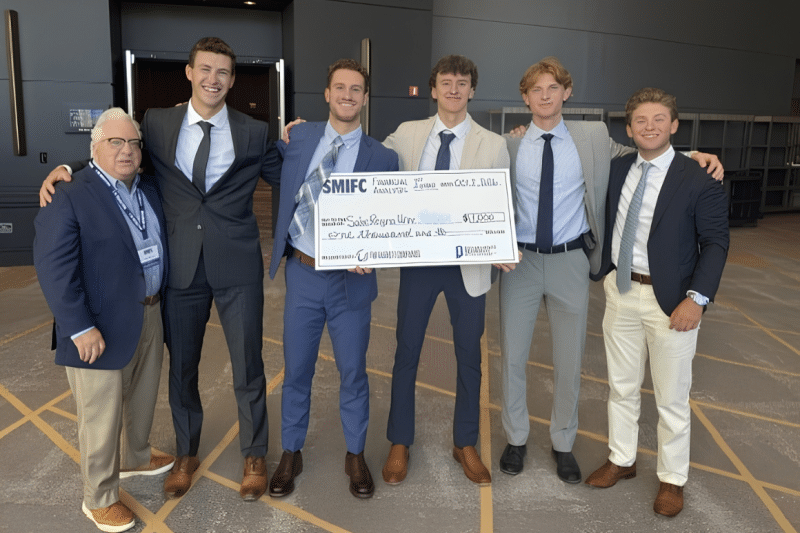

Xavier Johnson '28 explores AI ecosystem, ethics and platforms in Compass Summer / "AI Futuremakers"
Students delve into the wider context around artificial intelligence technologies and get hands-on time to build and test apps.
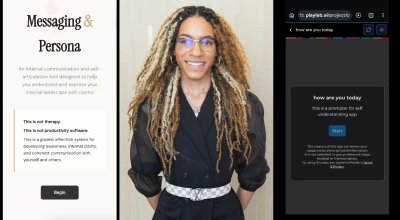
Xavier Johnson '28 is intrigued by innovation – not just technological advancement, but, as they put it, "the cross-section of person, software and system." The Las Vegas native is majoring in global business and economics with a minor in sociology and anthropology. They intend to apply for Salve Regina University's combined bachelor's/master's in business program at the end of this year.
When Johnson learned that Salve offered the Compass Summer program "AI Futuremakers: Exploring artificial intelligence from code to creativity" they delayed their trip home for the summer to participate in the one-week session that ran May 11-15.
Led by Dr. David Altounian, associate professor of business and economics, the program offered an immersive experience that bridged basic AI knowledge with creative exploration and hands-on labs, providing technical skills and ethical awareness to help students navigate the AI-powered world around them.
"I have a real affinity for innovation and was interested in seeing how Salve would approach AI," Johnson said. "In classes and around campus there are so many conversations about AI. It's so polarized! I wanted to know how the Sisters of Mercy ideology lives alongside AI. Since the course was grounded in the real world I also looked forward to the chance to geek out."
Hands-on with AI tools
Johnson had prior AI coding experience, having built mental health and life coaching apps to launch their perception design agency, The 21st Muse, using ChatGPT, Claude and Gemini, designing in Canva and building their website using Shopify's Magic tool. They ran the site as a pilot project for six months, reaching 500 views, before putting it on pause.
"That experience really developed my curiosity around AI's capabilities," Johnson said.
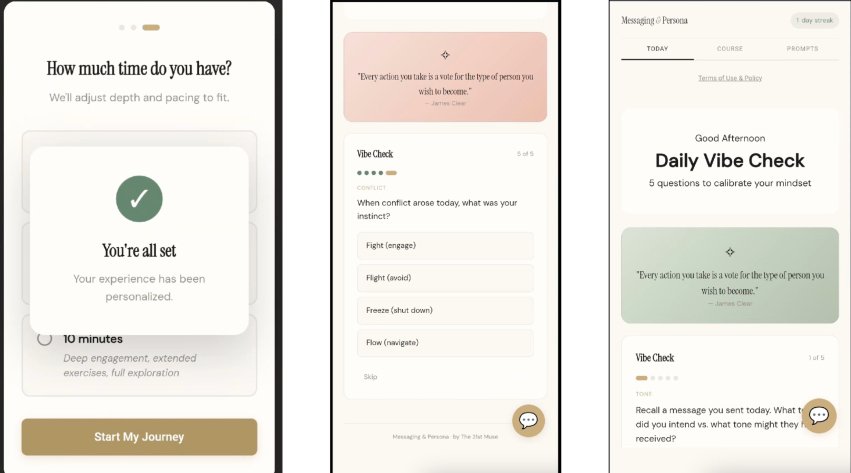
They took the opportunity of the Compass Summer program to extend their most developed app, redesigning it in Gamma and using Replit for coding, along with Claude and ChatGPT.
Johnson said, "I added agents and tools so people could talk to a chatbot. The earlier app had a dashboard but not a great user experience. Through the Compass program, I learned how to incorporate AI tools and really advance this into something professional."
The course went deeper than working with technology and tools, Johnson noted. "With AI apps, a lot of this feels like magic – things happen but not physically. It was great to learn from someone with the experience to make sense of the magic. We did a lot about how AI works, how users think and how to best communicate with the technology."
They explained, "Dr. Altounian would lead a discussion on prompt generation, that led to context generation, then we'd hear more about AI agents and IP agents. He would adjust the class to align with what we were doing, giving us prompts to help us think. It was conversation, prompt, conversation, lab. It was an amazing program and truly meant for everyone."
Beyond the prompts
Johnson noted that every day of the class included an ethical component related to what they were working on. "Touching those bases showed us how organically the issues we come across in AI connect to the values of the school."
They explained, "In learning about the chips needed to run AI we got insight into why AI uses so much electricity, and that led to discussions around steam cooling and recycling water, and the different effects of mass energy consumption. These are systemic problems that need to be addressed. We lose sight of this when people are focused on being afraid to lose the AI race. AI innovation seems to be led by fear instead of policy."
The short summer "AI Futuremakers" session provided the key connective tissue Johnson was looking for. "You have the technology on one hand; the software, like ChatGPT. Then the AI companies like OpenAI. Around it all are cultural systems trying to maximize AI for different things, whether that's for caregiving, for workplace productivity or something else. Finally, you have the individuals who are engaging with the software. We talked about all of those systems."
"AI is a machine," Johnson said. "It's not sentient. I think AI software has the ability to do more that is helpful than hurtful. On a software level, AI can align with the critical concerns of the Sisters of Mercy, but it's being developed in an environment where that's not necessarily the focus."