Students turn Newport's hidden history into interactive scavenger hunts
In the Compass Summer program "Walking Through History," students traced the steps of philosopher George Berkeley, explored historic landmarks and created interactive scavenger hunts for future visitors.
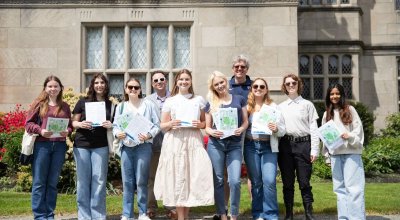
For two weeks in May, a group of Salve Regina University students traded classrooms for historic mansions, colonial landmarks, hidden architectural details and winding Newport streets, all in the name of discovering the stories that surround them every day.
As part of the Compass Summer program "Walking Through History: Creating Historical Tours Through Newport," students explored the city's rich architectural and cultural history while developing scavenger hunts designed to help others experience Newport and Salve's campus in a new way. Led by Dr. Jeroen van den Hurk and Dr. Craig Condella, the program brought together students from a variety of majors and backgrounds, creating a collaborative environment where history, philosophy and creativity intersected.
One of the program's central projects focused on Whitehall Museum House, the 18th-century home of Irish philosopher George Berkeley. While many Newport visitors are familiar with the city's Gilded-Age mansions, Whitehall remains one of the region's lesser-known historic treasures.
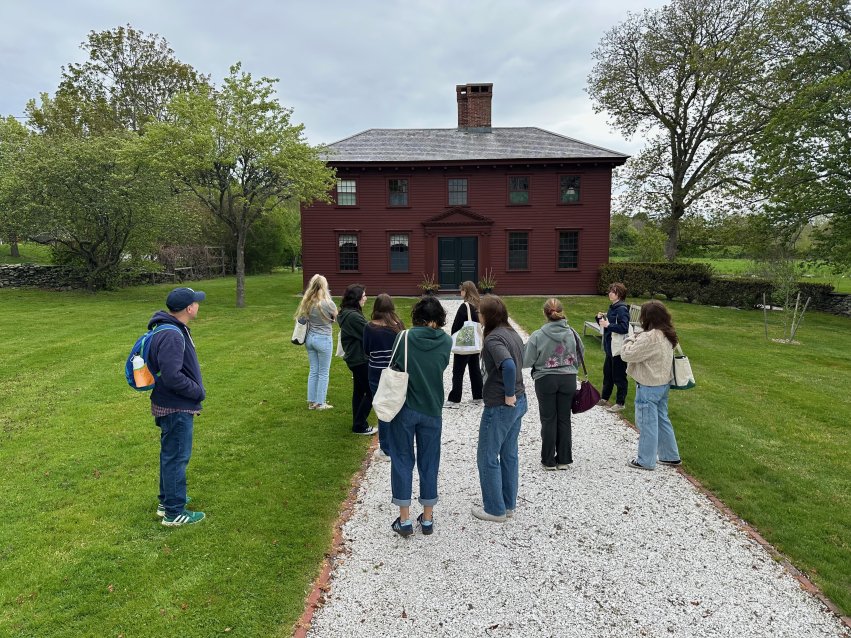
Students also worked closely with members of the Colonial Dames, the organization that preserves and interprets the property, while exploring Berkeley's connections to Newport and Rhode Island history.
For Gracie Kolbenschlag '27, a cultural and historic preservation major on the pre-law track, the program offered a chance to dive deeper into her field.
"I didn't know about Whitehall, and I don't think a lot of people know about it," Kolbenschlag said. "This house has so much history. It's gone through so many lives."
She added, "I'm actually planning on doing my senior thesis out at Whitehall now, because of this program. There’s a burial site at Whitehall that they don't know the exact location of, and I’m thinking about doing some ground-penetrating radar work there. It would be really cool to take what I learned during Compass Summer and keep going with that."
For Morgan Vreeland '27, a theater arts major with a technical concentration and an art history minor, the program represented an opportunity to combine her passion for research and history.
"I really like working on historical projects. A lot of the work I do in the theatre department is focused on dramaturgy, making displays and getting the full historical context of shows. This fit very well in line with what I want to be doing, and what I find really interesting outside of my specific major."
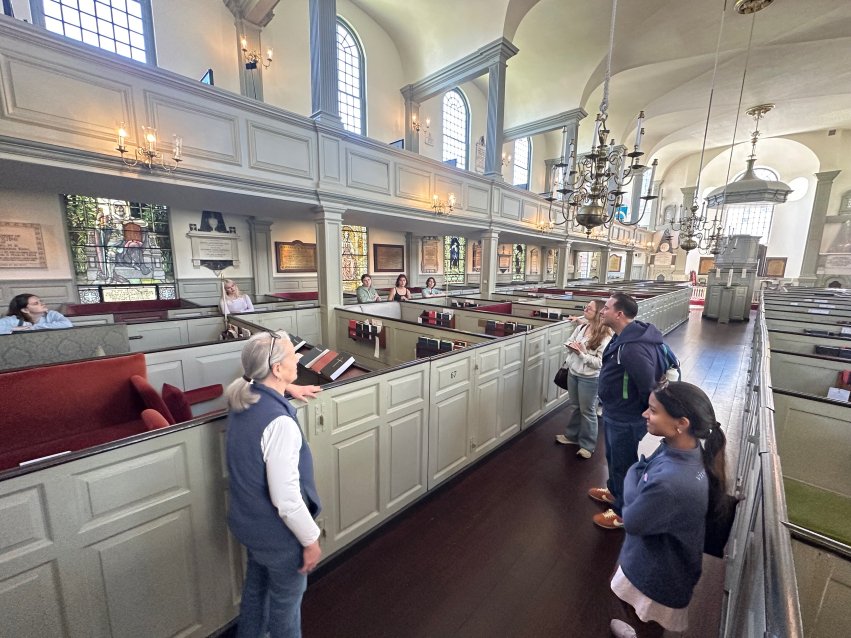
Throughout the program, students visited sites across Newport and Middletown, including Whitehall, Trinity Church, Redwood Library and Athenaeum and numerous historic locations on Salve's campus. They explored how Berkeley's ideas influenced the city and examined the layered histories behind landmarks many pass every day without a second thought.
The group also explored broader Newport history, including discussions surrounding the mysterious Newport Tower and the evolution of the land that would eventually become Salve's oceanside campus.
"There's so much to learn right in front of you," Vreeland said. "You become accustomed to the buildings that are here now. During this program, we were reminded that there's a really rich history there, and there are so many details you probably haven't even noticed before."
History as an experience
Rather than simply studying local history, students were tasked with finding a way to share it.
Their solution: four interactive scavenger hunts – easy and hard versions for both Salve's campus and the George Berkeley/Whitehall route.
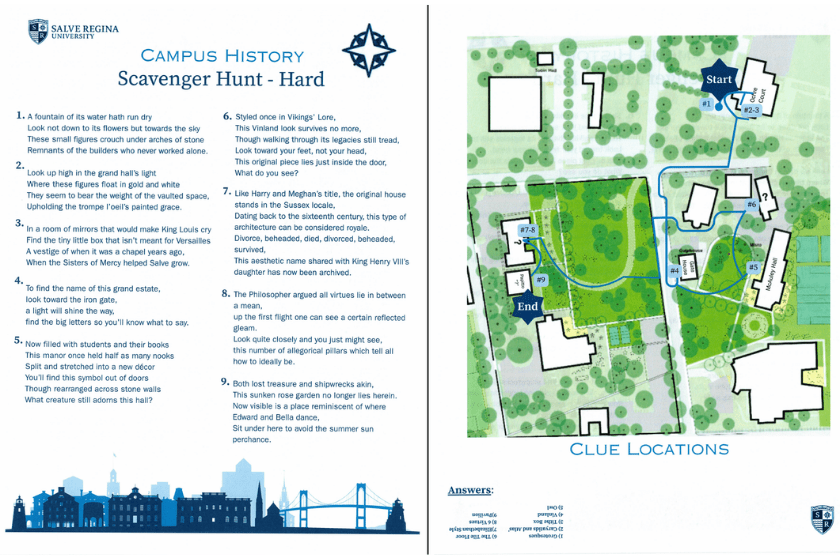
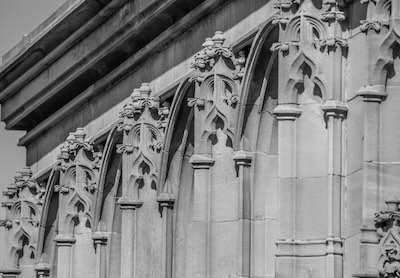
The campus scavenger hunts guide participants through locations including Ochre Court, McAuley Hall, Gerety Hall and other significant sites, encouraging visitors to look beyond the buildings' beauty and engage with their histories. The Whitehall scavenger hunts connect Trinity Church, the Redwood Library and Whitehall itself, highlighting Berkeley's influence throughout Newport while encouraging more visitors to discover the museum in Middletown.
"We really wanted to get people who are in Newport out to Middletown, and we did so by starting at a place like Trinity Church, which is a well-known, iconic building. The scavenger hunt might be able to bring people out to Middletown to see the house, too, which is just as rich with history," shared Kolbenschlag.
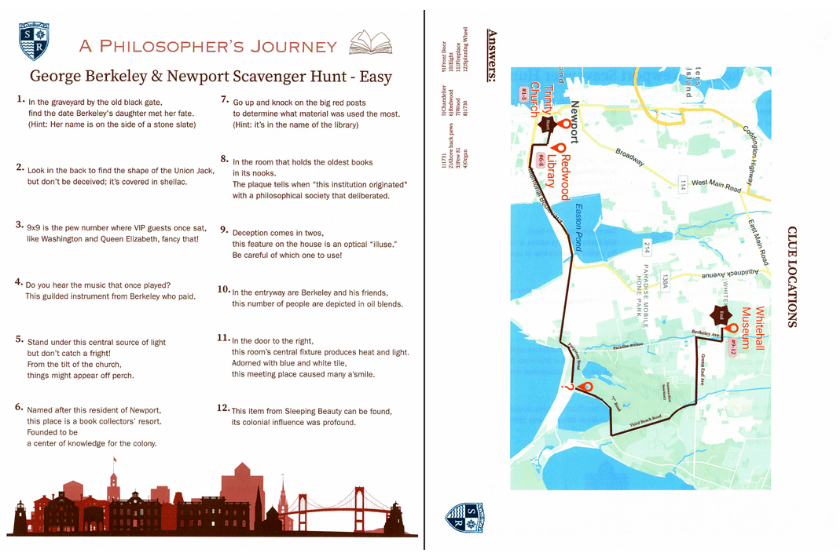
Creating the scavenger hunts became a lesson in collaboration. Students from different academic disciplines contributed unique perspectives, from historic preservation and philosophy to literature, theater and communications. Together, they decided to write many of the scavenger hunt clues in rhyming verse, adding an extra layer of creativity to the experience.
"The literature majors were getting really creative with how they were doing these rhymes, and the media they were bringing into the discussions was really fun," said Vreeland.
For Kolbenschlag, working alongside students outside her field helped her think differently about public engagement.
"It was cool to learn from some of the students in communications and marketing," she said. "Being able to take history and something people don't know a lot about and make them excited to learn about it was really valuable."
For both students, the program reinforced one of Compass Summer's greatest strengths: the opportunity to explore something new without the pressure of a traditional course.
"I think these programs can open up the possibility for students to do something that they probably wouldn't do otherwise," Kolbenschlag said.
Vreeland agrees.
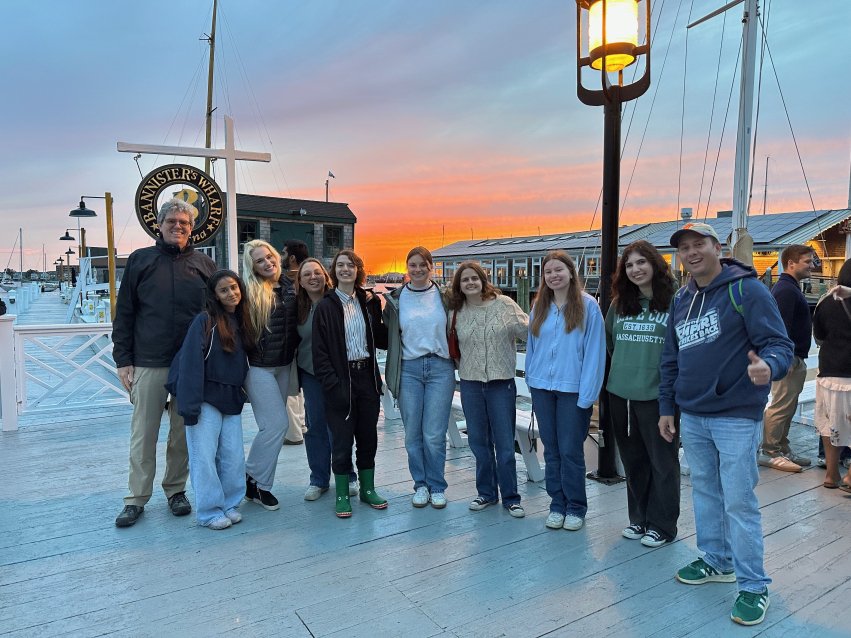
"Go for it," she said. "Even if the programs aren't your exact interests on paper, just having the opportunity to be in Newport for two weeks after academics have ended is so nice. I experienced more of Newport in those two weeks than I probably did in the past two years."