

Gloria Doliscar '27 makes new discovery in Parkinson's research
Her research uses math, computation and biology to uncover an unknown effect of electrical stimulation on impacted cells.
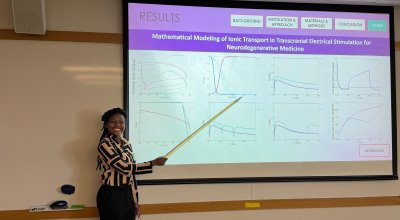
Gloria Doliscar '27's undergraduate research can take her from the inner workings of a brain cell to lines of computer code to a room full of mathematicians – sometimes all in the same project.
Working alongside Dr. Ed Dougherty, associate professor and chair of the Department of Mathematical Sciences, Doliscar has spent the past year using math, computation and biology to investigate a complicated question: How does electrical stimulation affect cells impacted by Parkinson's disease?
The interdisciplinary project has given Doliscar, a biochemistry major and math minor, an opportunity to approach a major health challenge from multiple directions, pulling together skills from across her Salve Regina University education while learning plenty more along the way.
"Each discipline is like a different piece of a puzzle," Doliscar said. "If you only have one of them, it's not a complete picture, which is why research like this is so important."
Using math to understand Parkinson's disease
There is no cure for Parkinson's disease, but researchers have explored transcranial electrical stimulation, or TES, as one way to influence brain activity and potentially alleviate symptoms. Exactly how that stimulation produces its effects, however, is still being investigated.
Rather than experimenting directly on the brain, Doliscar and Dougherty use mathematical equations and computer models to simulate what may be happening inside neurons.
"If we can pinpoint how it works, they can make other methods or better treatments for Parkinson's," Doliscar said.
During the summer, Doliscar focused on neuronal ions, which play an important role in how neurons function. She added ionic channels to an existing computer model and examined how these charged particles behave in a healthy cell compared with one representing Parkinson's disease.
"We saw that altered ionic activity in the Parkinson's cell actually makes its functioning resemble that of a healthy cell," Doliscar said.
These findings could augment traditional Parkinson's research, opening a new avenue for researchers studying how electrical stimulation affects the disease. If further research supports what Doliscar and Dougherty observed in their model, the discovery could help researchers better understand how the stimulation works and ultimately inform the development of more targeted treatments.
No protocol, no predetermined answer
Getting to those findings has rarely been a straight line.
Some days, Doliscar pores over biology research looking for an equation that could work in the model. Others are spent coding, testing results or debugging when one small change unexpectedly throws everything off.
It is a different experience from the structured labs she was accustomed to in her coursework.
"In lab settings, in biological chemistry, they're more guided," Doliscar said. "You have the protocol. You follow the protocol. You have the results. Research is more like you have no idea where it's going. You are just working and seeing where it takes you."
Dougherty has also given Doliscar room to help determine where that work goes.
At one point, a research paper Doliscar found led her toward a different explanation for what she was seeing in the model. Dougherty encouraged her to pursue it. After digging deeper, she discovered the process happened over a much longer period than the fraction of a second they were studying, so they pivoted again.
"If I was finding something else, I was just going along with that. Dr. Dougherty gave me a sense of ownership over the research, which provided me with the independence and confidence to explore questions I was curious about, regardless of whether they produced anything," she said.
That freedom has meant learning concepts as she needs them. Her calculus and biology courses at Salve provided a foundation, but portions of the project required mathematics she had not yet taken in class and a new programming language.
"It sounds silly, but one of the things that surprised me the most about this opportunity was that I ended up really liking coding," Doliscar joked.
Bringing her research beyond Salve
Doliscar has since taken that work beyond campus, presenting at several scholarly gatherings, including the National Joint Mathematics Meetings in Washington, D.C., and research events at Brown Health and with RI-INBRE at the University of Rhode Island.
The interdisciplinary nature of the project means the story she tells changes depending on who is listening.
At science-focused conferences, she emphasized neurons, ionic channels and the biology behind Parkinson's. At the national mathematics meeting, she reversed that approach.
"The biology-medical part, I was giving it more as background, and the math aspect was the big chunk of my presentation," she said. "These are the equations we use. This is how it works and this is how those got us our results."
She even 3D-printed models of the channels she was studying, giving conference attendees something they could hold while she showed how calcium ions move through them.
Those presentations have put Doliscar in scholarly spaces extending well beyond a typical undergraduate classroom. At one conference, she presented primarily alongside other undergraduate researchers. At others, she found herself sharing research in the same setting as graduate students, Ph.D. students and people already working in the field.
It was a significant shift for someone who describes herself as an introvert and initially approached conference presentations with plenty of nerves.
"Presenting at all of these conferences kind of pushed me out of my comfort zone more and more, and now I'm more comfortable to speak in public," Doliscar said. "I've definitely grown my communication skills."
The independence of the research has built confidence beyond public speaking, too.
"Learning this type of interdisciplinary research and getting the independence in a lab setting makes me feel like I actually can do this," she said. "My self-confidence grew."
Doliscar is continuing the project this academic year. Much of her research so far has used a two-dimensional model focused on a single neuron. Next, she and Dougherty plan to build on their findings with a more complex three-dimensional model involving multiple neurons – giving them what Doliscar calls "a fuller picture."