
Communications and creative writing alum Morgan Rizzo '23 builds freelance career with Travel + Leisure, Business Insider and National Geographic
Rizzo shares the practical steps behind building a writing career, from gaining experience and networking to pitching national outlets.
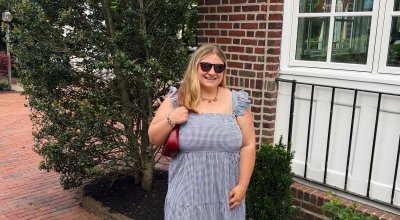
For Morgan Rizzo '23, a career in writing began with a realization during her first semester at Salve Regina University: She was in the wrong major.
Rizzo arrived at Salve planning to study elementary and special education, but it did not take long for her to notice that the excitement her classmates felt about becoming teachers was not something she shared.
By her second semester, Rizzo had moved into communications, eventually adding creative writing and publishing as a second major. The combination gave her opportunities to experiment with everything from journalism and feature writing to fiction and poetry, while gaining professional experience through Salve's Office of Marketing and Communications and student publications.
Today, Rizzo works in social media marketing for A.T.Y. Hospitality, which encompasses Sift Bake Shop, Mix Restaurant & Rooftop, Young Buns Doughnuts and A.T.Y Bar & Bonbons, while building an increasingly impressive freelance writing portfolio. Her work has appeared in Travel + Leisure, Business Insider, National Geographic and publications throughout Rhode Island and New England. Her assignments have taken her to destinations across the region, while teaching her the less-visible side of freelance writing.
Rizzo reflects on finding her path at Salve, landing that first byline and what students should know about turning a love of writing into a career.
Q: You originally came to Salve as an education major. How did you realize writing was the direction you wanted to pursue?
A: I enrolled at Salve because of the education program. My high school was very science- and math-oriented, so careers were always presented as engineering, nursing, medicine, technology or teaching. No one really pushed English or writing as something you could pursue professionally outside of teaching.
I loved kids and always loved school, so I thought, "Maybe I'll be a teacher." But when one of my professors talked about her own career path and how writing had always remained part of her life, I ended up telling her about a senior project I had done in high school where I baked cookies with people and then designed and wrote a book about it. I had always loved writing and designing things.
She basically told me, "You're in the wrong major," and encouraged me to look at the English department. I talked with former department chair Dr. Matthew Ramsey, and by my second semester, I had switched into communications.
Q: What inspired you to add creative writing and publishing as a second major?
A: I started with the communications major, and then I took the course CWP250: Intro to Creative Writing as an elective. I loved the class and the way it was taught.
I had never thought of myself as someone who would write fiction or novels. Communications was more closely connected to the feature and journalistic writing I do now, but creative writing gave me a completely different way to think.
A lot of the classes overlapped between the programs, so I realized I had room in my schedule and added creative writing. They complemented each other really well. Communications gave me that journalistic and professional foundation, while creative writing added another layer to my writing and encouraged me to challenge myself.
Q: Was there a Salve class that had a particularly big impact on your career?
A: The course COM371: Feature Writing with Dr. Donna Harrington-Lueker [professor emerita] is definitely No. 1.
That class introduced me to the magazine-style writing that I really love. I wrote a story about Sift Bake Shop for an assignment, and Dr. Harrington-Lueker loved it. She told me there was a Salve alumni, Shannon Cushing '05, who was an editor at The Day magazine in Connecticut and asked whether she could send it to her.
She told me not to get my hopes up because it might not become anything, but I was grateful just to have someone read it. Then Shannon emailed me and said she loved the story and wanted to publish it. It eventually became the cover story of the magazine's February edition that year.
I had already written a lot through Salve, but this was my first piece published outside of the University – and I got paid for it, which was also exciting. From there, Shannon kept assigning me stories, and I wrote for the magazine for a little over a year. That class really was the start of everything.
Q: How did one magazine story turn into writing for outlets like Business Insider, Travel + Leisure and National Geographic?
A: After The Day, there was a period when I wasn't doing much freelance writing because I didn't really know what else was out there. I still wrote some alumni stories and pieces for Report from Newport through Salve, but I hadn't figured out how to find other opportunities.
Then, while I was working at Sift, I met Elyse Major, the editor-in-chief with Hey Rhody Media Co. She happened to come into Sift for something she was working on. I introduced myself and told her I did social media marketing but also loved writing and wanted to continue doing it on the side.
She gave me her business card, and I followed up. I showed her what I had written at Salve and for The Day, and she assigned me a story for SO Rhode Island magazine.
That was when I started realizing that assignments were not always going to simply come to me. I needed to pitch.
Another important connection was Andrea McHugh, a Newport-based freelance writer whose work I had seen in a lot of different publications. I reached out to her and asked if she would meet me for coffee and talk about freelancing. We met at the Nitro Bar in Newport, and after looking at my work, she told me, "You should pitch Business Insider."
I remember thinking, "Business Insider? That's crazy."
But I looked into what they published and pitched a first-person story about my grandmother living with my family after a house fire. An editor got back to me and wanted the story.
Once that happened, I thought, "OK, where else could I go?"
I started researching other publications and eventually began pitching Travel + Leisure. The first editor I contacted responded – but said no to the idea. Even getting a response felt better than getting no response at all, so I kept trying.
Eventually, I pitched a story about my hometown of Westerly, Rhode Island, and that one landed. From there, I kept sending ideas.
That's really how it has happened: one clip gives you something to show the next editor, and one connection can lead you to another opportunity.
Q: For students who have never freelanced before, what actually happens when you "pitch" a story?
A: A lot of it is networking, sending emails and waiting for responses.
The pitch is basically your argument for why this story should exist and why that publication should publish it. I think clear and concise is best, and you need to tailor it to the outlet because every publication has a different style.
You also introduce yourself and show them your experience and relevant clips.
There's "cold pitching," where you email an editor you've never spoken with before, and sometimes that works. Other times, you might connect with someone on LinkedIn first and get their work email, which makes it more of a warm introduction.
Once you already have a relationship with an editor, it can change a little. With one of my Business Insider editors, for example, we have a really good relationship now. I might ask what she is looking for seasonally, and instead of sending a formal pitch, I can send a few New England towns and quick ideas. She might choose one, and then I'll expand on it.
With Travel + Leisure, I'm still primarily pitching my own ideas. It really depends on the publication and the relationship you build with the editor.
Q: Rejection and silence are obviously part of that process. How do you keep going when an editor says no – or never answers?
A: Rejection is definitely a big part of freelance writing.
At the beginning, I would send an email and think, "Why aren’t they answering?" I'm always checking my email, and when I see one from an editor, the writing nerd in me gets so excited. I want to respond immediately.
But there is a lot of silence. I've reached out to writers or editors on LinkedIn and got no response. The same thing happens with pitches.
One thing I've learned is to follow up. Sometimes your email was missed, ended up in spam or just got buried. I'll usually follow up after about two weeks. Sometimes I'll send two follow-ups, and if I really believe something is a great fit, I might send a third.
Eventually, you get more comfortable with it. If someone doesn't respond, you keep moving.
It is also a competitive industry. There are a lot of talented writers and freelancers trying to do the same thing. But connecting with other freelancers has helped me realize everyone experiences that.
Q: A lot of your work focuses on travel, food and New England. What does that career look like behind the scenes?
A: I grew up in Westerly and then absolutely fell in love with Newport when I went to Salve, so being able to write about places I genuinely love has been really special.
My first Travel + Leisure story covered my hometown, and my first National Geographic byline covered Rhode Island. There's something really cool writing about where you live and where you grew up.
Editors are also looking for that local expertise, wanting to tap "experts." If you've lived somewhere your whole life, that can give you a perspective someone visiting for the first time might not have.
Freelancing has also introduced me to the PR side of travel writing, which I didn't understand at first. Once you have published work, PR professionals may reach out representing destinations, hotels or restaurants. When I have a story in progress, I might contact a destination's PR representative to learn what is new, what hotels might fit or what restaurants I should know about.
Sometimes that can include hosted hotel stays, meals or other experiences, which is exciting, but there's another layer to it because nothing guarantees that a pitch will ultimately become a published story.
I also create social media content from a lot of my trips. Since my full-time job is in social media marketing, I've always enjoyed photography, Instagram and content creation. If I'm visiting these places for a story, I enjoy documenting them too.
There's increasingly this crossover between being a journalist and a content creator. It adds extra work, but it also opens up another way to tell the story.
Q: How did writing professionally while you were still at Salve help you break into freelancing?
A: It was incredibly helpful because when you pitch an editor, you need to show them that you can write.
Before I had national bylines, I could send editors the stories I wrote through Salve's marketing and communications office, Report from Newport or Mosaic, Salve's student newspaper. Those were professional clips I could point to.
Students sometimes think, "It's only a college publication," but it’s still published work. People can read it. You can link to it. It demonstrates what you can do. That experience gave me something to build from when I was just getting started.
Q: How important has networking been throughout your career?
A: I networked a lot at Salve, and I still do it constantly. Almost every day or every week, there is someone new I'm connecting with, whether I reach out to them or they reach out to me.
That's how my career started: A professor connected me with a Salve alum, which led to my first freelance magazine work. For students, I would recommend having LinkedIn and connecting with writers in your area, editors, alumni and people doing work you find interesting. Ask questions. Reach out.
Q: What would you tell a student who loves writing but wonders whether writing is a "practical" path?
A: Start writing before you graduate. Write for campus publications. Publish your work online – Substack is really popular right now, for example. Build clips. Get on LinkedIn. Connect with people. You can even start pitching publications while you're still in college.
Before I did this, I never would have thought I could land a piece in Business Insider. Now I see stories from all kinds of contributors – parents, students, people writing about something they experienced firsthand. There are so many different ways into this industry and as long as you have the passion for it, it can be just as practical as any other field.