
Salve's Aryana Wilson '27 helps Caribbean women's national hockey team capture a title
Standout defender turns her college ice hockey experience into international success.
When Aryana Wilson '27 was finishing high school, she wasn't entirely sure college hockey was in her future. She had been playing since she was five years old, but as her senior year approached, doubts crept in. Did she still want to play? Was she good enough to compete at the college level?
Four years later, Wilson has an answer – and two international tournament championship wins to help prove it.
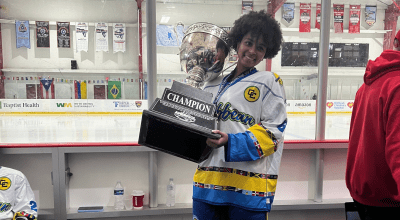
This summer, Wilson helped the Caribbean women's D1 national team capture first place at the AMERIGOL Latam Cup, an international hockey tournament featuring teams representing countries and communities from around the world.
For Wilson, a senior biology major and marketing minor at Salve Regina University, the championship was more than another hockey accomplishment. Her experience with the Caribbean team has connected her with players and coaches from different backgrounds, strengthened her game at Salve and inspired a larger goal: helping make hockey more accessible to players who might not otherwise have the opportunity to play.
"It meant a lot because one of my goals after graduation was to start a nonprofit for hockey players of color," Wilson said. "I meet so many people at these tournaments."
From Salve to the Caribbean team
Wilson was drawn to Salve by its smaller class sizes, Newport location and the opportunity to continue playing hockey.
Being part of Salve's women's ice hockey team quickly gave her a community on campus.
"I was nervous coming into Salve, not knowing anyone, but having the team helped a lot. They quickly became a support system," she said.
That support has extended into the classroom. As a biology major, Wilson found teammates taking similar courses who became study partners, while morning practices allowed her to dedicate evenings to academics. She has also built relationships with professors across her major and minor.
Wilson's development at Salve has followed her onto the ice beyond Newport. She first joined the Caribbean team in 2024 after being invited to a practice by a coach who had previously recruited her. The team brings together players with Caribbean ancestry from different levels and backgrounds, including other collegiate athletes.
Wilson's team won the Latam Cup in her first year, returned for a second-place finish in 2025 and entered this summer hoping to bring the championship back.
"I can take what I've learned from Salve and apply it to my team," Wilson said. At the same time, advice from the coaches and players she encounters internationally gives her new perspectives she can bring back to the Seahawks. "It's great being able to use my experiences with both teams to make each stronger, and myself stronger as well."
More than a championship
This year's title came down to overtime.
Facing the Lebanon national team in the championship game, the Caribbean team remained tied 1-1 through regulation before one of Wilson's teammates scored the winning goal.
The victory marked Wilson's second Latam Cup championship experience in three years. But some of the most meaningful parts of those experiences have had nothing to do with winning the cup.
Through international competition, Wilson has encountered players with vastly different access to hockey. This summer, the Caribbean team faced the national teams from Argentina, Egypt and Lebanon. Wilson was particularly struck by the Argentinian team, that field some players who had limited access to ice, and had developed their skills through roller hockey.
Those experiences have made Wilson think more deeply about the barriers surrounding a sport she has played nearly her entire life.
"I hope that it brings more people together and allows more people to want to try hockey," she said. "It's a very hard sport to try at first, and it's an expensive sport as well. But having access to programs like this can change someone's life."
Wilson hopes the attention surrounding tournaments like the Latam Cup can help create programs that provide younger players with access to equipment, ice time and opportunities to simply try the sport – while giving women more avenues to continue competing.
"By bringing all this attention to the sport, it could help start programs for younger kids that might not have access to these things," Wilson said, "and grow the game of women's hockey."
Inspired partly by people she has met through the Caribbean team, she hopes one day to establish a nonprofit supporting hockey players of color.
Keeping the door open
Wilson plans to return to the Caribbean team next summer. After graduating from Salve, she hopes to pursue a master's degree, potentially continue playing club hockey and eventually explore opportunities to play overseas.
For someone who once questioned whether she should play college hockey at all, the possibilities now look considerably different.
Continuing the sport brought Wilson to Salve. Her experience as a Seahawk helped prepare her for international competition. And the opportunities she has found through both are shaping how she hopes to give back to the game.
"If I didn't ever try hockey at Salve, I wouldn't have this opportunity, and both have changed by life for the better," Wilson said.