

Pell Center Survey: Foulkes leads governor's race by 11 points, lieutenant governor contest is deadlocked
New Salve Regina University survey finds strong congressional incumbents, a competitive governor's race, and a statistical tie for lieutenant governor.
Democratic candidate Helena Foulkes leads the Rhode Island gubernatorial race with 39% support among likely voters, while the race for lieutenant governor remains statistically tied, according to a new survey from Salve Regina University’s Pell Center. The survey was directed by Pell Center Associate Director and Fellow Katie Sonder and fielded by Embold Research between October 5-8, 2026. The survey included 815 likely Rhode Island midterm voters and has a margin of error of ±3.6 percentage points.
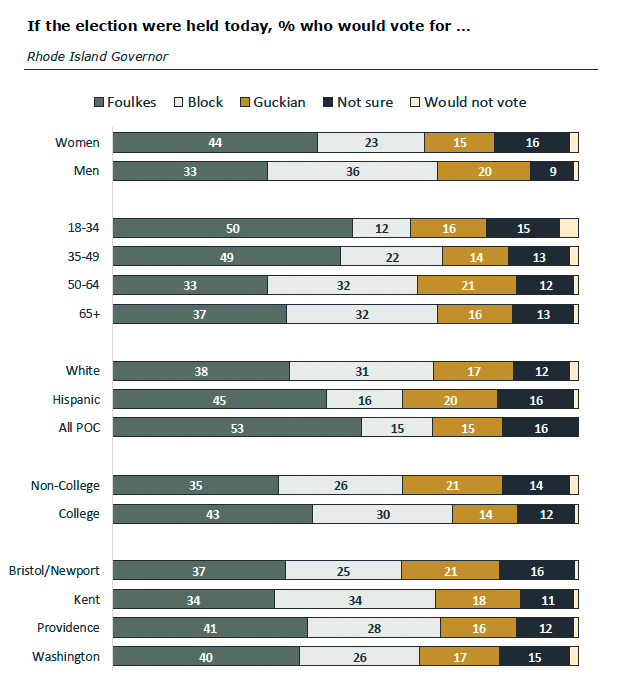
Foulkes leads by 11 points, followed by Independent Ken Block (28%) and Republican Aaron Guckian (17%). Foulkes leads across major demographic subsets and has the strongest support among women (44%), people of color (53%), and college-educated voters (43%). While support for Block and Guckian does not individually outweigh support for Foulkes, their combined vote share surpasses hers in some demographic groups, including across all Rhode Island counties. Thirteen percent of likely midterm voters remain undecided.
The closest contest tested is the lieutenant governor's race, where incumbent Sabina Matos (43%) and John Loughlin (44%) are statistically tied. Matos performs well among women (53%) and Hispanic voters (56%), while Loughlin has stronger support among men (58%) and white voters (47%). Kim Ahern (52%) leads Alan Gordon (34%) in the Attorney General’s race, while 13% of likely midterm voters remain unsure.
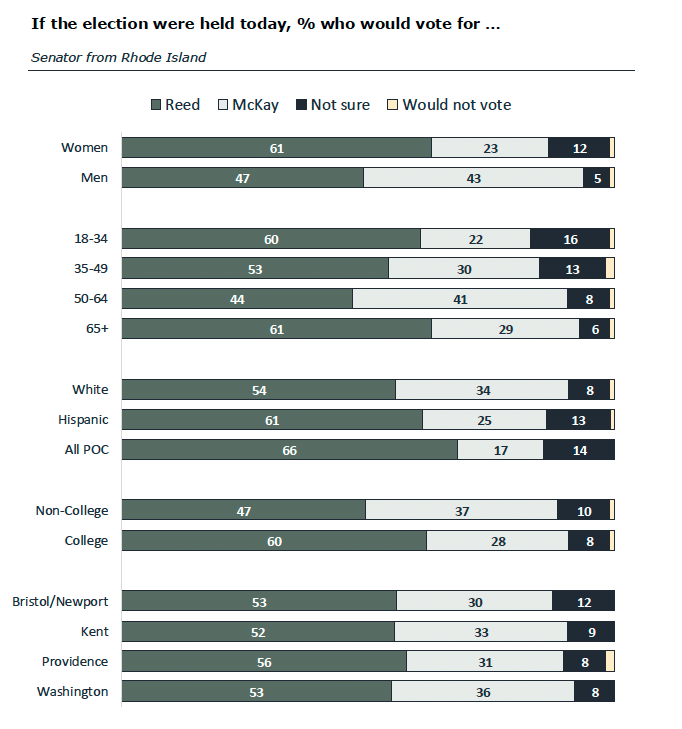
Among congressional races, incumbents receive over 50% support. Senator Jack Reed (55%) holds a 23-point lead over Republican challenger Raymond McKay (32%). Reed has at least 60% support among women, voters aged 18-34 and 65+, people of color, and college-educated voters. Among the Rhode Island counties, his strongest support is in Providence County (56%).
Both incumbent members of the U.S. House of Representatives, Gabe Amo and Seth Magaziner, receive 52% support, though the race for Rhode Island’s 2nd Congressional District is more competitive. Victor Mellor (39%) trails Magaziner by 13 points, while Kellie Keenan (33%) trails Amo by 19 points. Both Amo and Magaziner earn majority support from every age group except those 50 to 64, where Mellor leads Magaziner by 9 points (51% to 42%) and Amo trails Keenan by 3 points (43% to 40%).
“While congressional incumbent candidates appear to have strong leads, likely midterm voters are more divided in the races for governor and lieutenant governor, where important distinctions emerge across demographic groups and counties,” said Sonder.
This survey was conducted as a part of the Pell Center’s Voices of Value project that works to unpack the nuances of political polarization, understand media consumption habits, and track support for various political actors. The October 2026 survey is the seventh installment of the project.