
New Pell Center national survey finds Americans with strong authoritarian attitudes most likely to support violations of democratic norms
High-scoring authoritarians are more likely than low authoritarians to support changing election rules, censoring media sources and ignoring court decisions.
Americans with the strongest authoritarian attitudes are more likely to support political actions that violate democratic norms, according to a new survey from Salve Regina University’s Pell Center. While support for democratic norm violations is generally low across the population, high authoritarians—a characteristic identified through a series of questions designed to surface those sentiments—are more likely to support government actions like ignoring court decisions, censoring media sources, and changing election rules to disadvantage the political opposition.
The survey was directed by Pell Center Associate Director and Fellow Katie Sonder and fielded by Embold Research between May 4-12, 2026. It gathered responses from 2,034 likely voters in the United States, with a modeled margin of error of 2.2 percent. It examined how Americans perceive the health of U.S. democracy, democratic norm violations, and partisan identity, as well as the relationship between authoritarian attitudes and those views.
While support for democratic norm violations remains relatively low, substantial differences exist across partisan and ideological groups. Most Americans do not support election interference, but high authoritarians are more likely than any other demographic subgroup (gender, race, age, etc.) to support changing election rules to make victory harder for the opposition.
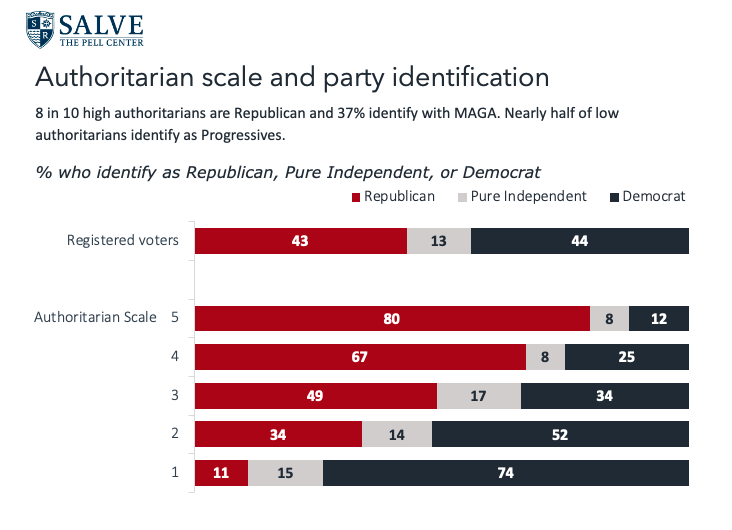
Additionally, higher levels of authoritarianism were strongly associated with conservative political identification. Of those scoring highest on the authoritarian scale, 80% were Republican or Republican-leaning. Of those scoring lowest on the scale three-quarters were Democrat or Democrat-leaning.
Finally, Americans remain deeply divided on the basic state of American democracy itself. While 95% of Democrats say the United States is facing a constitutional crisis, a majority of Republicans believe the country has a strong system of checks and balances and a thriving economy.
“It's heartening that so few Americans support actions which run counter to core democratic values, but I continue to be concerned that Americans are evaluating the same political system through very different lenses,” said Sonder. “Americans are assessing democratic health, institutional effectiveness, and economic conditions along partisan lines, making it increasingly difficult to build a shared understanding of reality.”
This survey is the fifth installment of the Pell Center’s Voices of Value project that works to unpack the nuances of political polarization. This report is the first publication analyzing the latest results. More analysis is to be published by Sonder on authoritarianism and affective polarization and Colin Woodard, Director of the Nationhood Lab at the Pell Center, on regional analysis.