McKillop Library 101: How students use Salve's "third space"
Looking to publish your own research? Need a source for your assignment, a place to do a group project or… a cookie sheet?
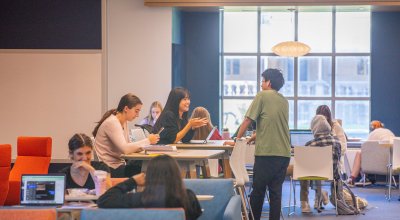
McKillop Library at Salve Regina University offers all that – and much more. Director of library services Dawn Emsellem-Wichowski ran down a brief list. "We do one-on-one consultations with students, teach classes, run programs to provoke scholarly and creative discussions, help students connect with the resources they need and of course, have helpful, friendly staff available day and night."
In fact, McKillop is arguably the most popular "third space" on campus – a social environment that isn't home, or a classroom, that is open to everyone (with snacks and coffee available!). The collection of print and e-books and journals is tailored to Salve academic programs and also includes a well-curated set of reading-for-pleasure material. There's even a library of things where you can borrow board or lawn games, bakeware and puzzles. Other than the Office of Public Safety, the library is the most-staffed service point on campus, where students can find supportive, helpful people from 8 a.m. to 1 a.m.
"We try to help students with whatever they need, whatever time it is," Emsellem-Wichowski said. "We know who to call and how to direct students; how to get them to the form they need on the registrar's website, find an office or sit with them to troubleshoot whatever issue they're having. Think of us as information triage on campus."
Information literacy takes center stage
In a world flooded with data and AI-generated information, having the skills to recognize fact and fiction is critical. At Salve, librarians help students develop information literacy – how to discover information, understand how it's produced, evaluate it, cite it and use it to create new knowledge. Their work touches every course, every discipline, and in some way, every student and faculty member. In 2025, 3,305 students were reached with information literacy education in 188 classes and librarian-produced research guides were viewed 6,500 times in September alone.
One hidden gem the library offers students is the opportunity to publish their scholarly work so it can be discovered by researchers anywhere in the world, through Salve's Digital Commons.
Emsellem-Wichowski explained, "Faculty can recommend that students submit excellent work, or students can submit their own work for consideration. Once it’s approved by a faculty member, it is posted and searchable. It's a great way for students to elevate their scholarly footprint. They learn about copyright and intellectual property – we consider this publication, and all the rules apply. It also shows them that the work they did is worthy of their time. There's another reason to be invested in it other than a grade."
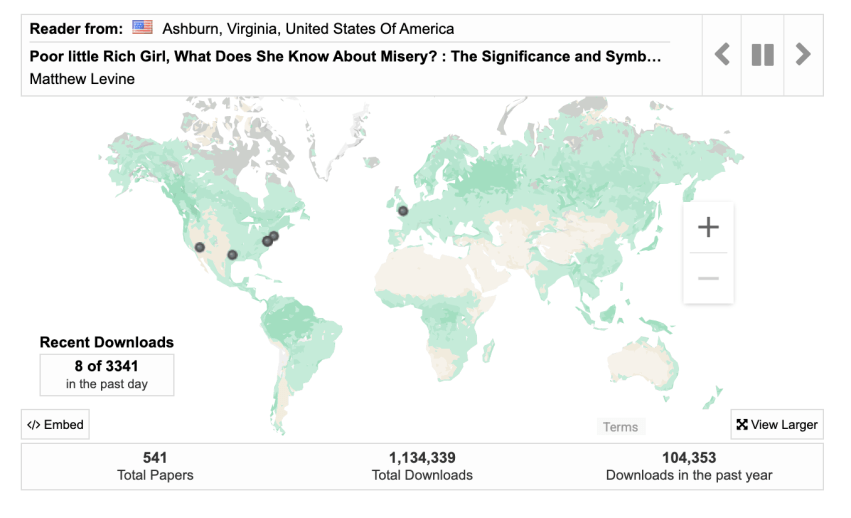
Students can check their published research to see how often it has been viewed or downloaded, and from where, on an animated map. A policy analysis paper on the homelessness crisis in New York City by Brian Koluch '27, for example, published when he was a first-year student in GLO100: Introduction to Global Studies, has now been downloaded 544 times. G. Smith-Rasmussen '26 published their research on the language of propaganda in CEG450: Capstone, a course for majors in the Department Cultural, Environmental, and Global Studies, in January 2026. It has been downloaded more than 300 times.
"Publishing on the Digital Commons demonstrates how students contribute to the scholarly conversation in their fields, and how their research has real impact, and is read and used by people all over the globe," Emsellem-Wichowski said.
By the numbers
Where does McKillop Library fit into the lives of Salve students? Every two years, we ask them through a survey. According to the latest one, out of 200+ undergraduate student library users polled:
- 102 said they visit the library weekly while 80 visit daily.
- 101 stay for one or two hours, 62 for more than three.
- Nursing majors use the library the most, followed by psychology majors, then education majors.
When asked what resources they prefer to use in the library, most students list multi-person tables and some background noise – they're going to study in groups. Right behind that are those who come to focus on their work individually, looking for single-person tables, study rooms and absolute silence.
Beyond the numbers
In open-ended questions, when asked what they like most about the library, one answer came up more than all others – the people, specifically library staff.
- "Staff are helpful, knowledgeable, friendly and welcoming."
- "I like how helpful the librarians are."
- "Everyone who works there is so nice."
- "I like the vibe and professionalism."
Emsellem-Wichowski summed it up, "Sometimes having a human work with you is more rewarding than an algorithm. Our culture at McKillop is 'we are here for students.'"