
Faculty Fellows Spotlight: Dr. Tim Neary
Dr. Tim Neary is a professor of history at Salve Regina University and a Pell Center Faculty Fellow. Since joining Salve in 2005, he has taught courses spanning U.S. history, including courses on public history, urban history, the intersection of religion and race in American society, sports history, and the modern civil rights movement. His research explores race, religion, sports, youth, cities, and community, as well as the ways in which personal experience can shape historical inquiry.
Q: What is your role at Salve, and what are your areas of teaching and research expertise?
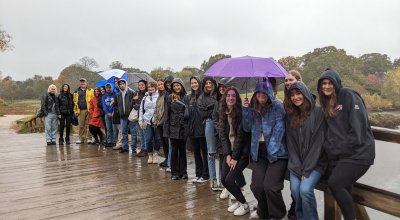
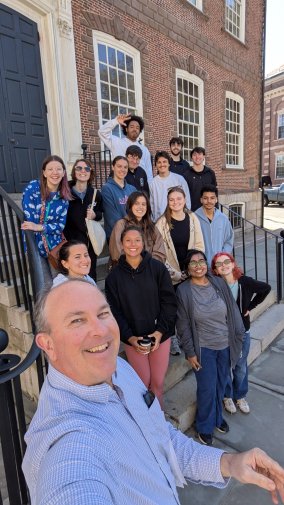
I’m a professor of history and have been at Salve since 2005. I teach a wide variety of courses, with most of them focusing on modern American history. They cover topics like religion and race in America, urban history, sports history, and the civil rights movement.
I also teach Introduction to Public History, which looks at history outside of academia, everything from museums and archives to the National Park Service and historical preservation. Newport is an incredible place to teach public history because we're surrounded by amazing historic sites. I always tell students that people travel from around the world to visit places that they can explore during a single class period.
Q: What sparked your interest in the topics you study?
When talking with our history majors about the discipline, one of the things I emphasize is that historians often choose topics that have a personal connection. My own story is very much part of my research.
I grew up in Omaha, Nebraska, as the youngest in a large Irish Catholic family. When I was in second grade, I was bussed for one year from my all-white neighborhood school to attend an all-Black school in North Omaha. Looking back, that experience had a significant impact on me. Later, at Georgetown University, I wrote my American studies senior thesis on St. Augustine's Church in Washington, D.C., known asthe "Mother Church of Black Catholics." I became fascinated by questions about race in American society and the role Catholic institutions played in urban communities.
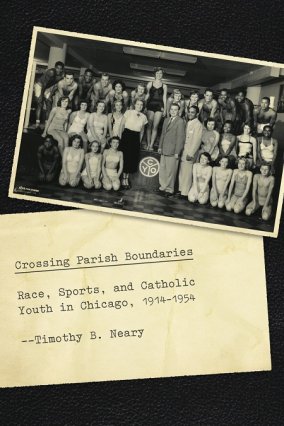
Graduate school took me to Chicago, where I studied U.S. urban history. My research eventually focused on interracial cooperation through Catholic-sponsored youth programs in mid-20th-century Chicago. I was interested in the idea that while neighborhoods and parishes were highly segregated, other parts of everyday life, such as labor unions and sports leagues, created opportunities for interracial cooperation.
Little did I know that I would eventually marry a Black Catholic woman and end up teaching at a Sisters of Mercy institution whose critical concerns connect so closely to the issues I've spent my career studying.
My own story is very much part of my research.
Q: How have the students at Salve influenced your thinking on the topics you teach?
They influence my thinking all the time, and thankfully so.
I've found that Salve students today are asking more "why" questions. I think the increasing diversity of backgrounds and experiences in the classroom contributes to opportunities for deep critical thinking.
Students continually remind me that while the past itself doesn't change, our understanding of it does. We discussed this recently in conversations about figures such as César Chávez, Martin Luther King Jr., and other historical leaders who accomplished remarkable things but often were also deeply flawed individuals. I think history is most useful when it allows us to grapple with those complexities rather than avoiding them. If we place historical figures on pedestals, they stop feeling human. Understanding their flaws gives us a more honest view of the past and, ultimately, more confidence in our own ability to shape the future.
The past itself does not change, but our understanding of it does.
Q: How are you involved with the Newport community?
One of my long-term research projects focuses on Newport's transformation after World War II, particularly its transition from a military economy to a tourism-centered economy.
I am interested in how Newport experienced many of the same processes that shaped larger American cities, including deindustrialization, urban renewal, redevelopment, historic preservation, and gentrification. These stories are often overlooked in favor of its colonial and Gilded Age history. But when the Navy dramatically reduced its presence in Newport during the early 1970s, the city was forced to reinvent itself.
What fascinates me is that Newport, despite its relatively small size, can serve as a case study for broader national trends. The city experienced many of the same challenges as larger urban centers, just on a smaller scale.
Q: What's one book you've read recently that you'd recommend?
I recently read The Secret War Against Hate: American Resistance to Antisemitism and White Supremacy by Steven J. Ross. The book is a fascinating, sobering, and ultimately hopeful story about heroic responses to the resurgence of white supremacy and antisemitism immediately following World War II through the mid-1970s. Civilian undercover agents from organizations like the American Jewish Committee, the Anti-Defamation League, and the Nonsectarian Anti-Nazi League risked their lives to infiltrate extremist hate groups, adopting false identities to pose as members of the American Nazi Party, Ku Klux Klan, and various other neo-fascist groups. In The Secret War Against Hate, Ross reminds us that we cannot always rely on government officials to protect U.S. democracy from internal threats. Everyday Americans sometimes must lead the way.