Digging deeper into Revolutionary War-era history
Inspired by Salve's Compass Summer program, Sydney Dufresne '26 is using advanced geophysical tools to explore and preserve Rhode Island's Revolutionary War-era sites.
By student writer Faith Lam '27
Sydney Dufresne '26 is an American history and cultural and historic preservation (CHP) double major with a minor in sociology and anthropology. After completing the Compass Summer program "Archaeology, Preservation and Geophysics" with assistant professors Dr. Heather Rockwell and Dr. Nathaniel Kitchel, Dufresne found inspiration to dive into archaeological geophysics in Rhode Island and the stories they tell of the American Revolution.
Her project "Subsurface Stories of the American Revolution: Archaeological Geophysics in Rhode Island" has allowed Dufresne to combine her various studies into hands-on research that she will present at Salve Regina University's annual SRyou Student Exposition on Wednesday, March 25.
Q: Can you introduce your project for the SRyou Student Exposition?
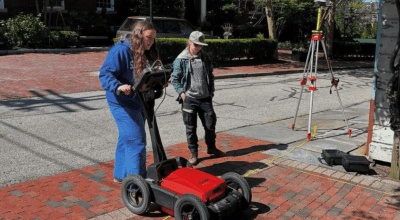
A: I am presenting research which applies archaeological geophysics to Revolutionary War–era sites in Rhode Island, with the objective of identifying subsurface features that inform understandings of conflict, occupation and preservation. I used ground-penetrating radar (GPR), electrical resistivity, magnetometry and GPS to detect buried anomalies at sites such as Conanicut Battery, the Windmill Hill Historic District and Vernon House. The result of this work contributes to the expanding research of archaeological studies on Revolutionary War-era New England and highlights the value of non-invasive methods for guiding future excavation and interpretation.
Q: What was your inspiration/motivation in deciding on your research topic?
A: I decided on taking up this research project after working on Dr. Rockwell and Dr. Kitchel's 2025 Compass program in exploring geophysics. I knew I wanted to do something archaeological related to the American Revolution since I had been working with the Newport Historical Society in preparation for the 250th anniversary of the Revolution coming up this summer, and thought that this was a great way to merge my history thesis which was on occupations of Newport during the Revolutionary War with what I was learning in cultural and historic preservation.
Q: Can you discuss the key milestones in the development of your project?
A: The development of this project progressed through several key milestones. I began by collecting all the research in the field. Then I went out with the Compass team to the different sites and set up grids, conducted GPR, magnetometry and resistivity on all the grids, and made sure we documented it properly. The next big milestone was completing all the maps in ArcGIS and making sure they were in the right location. After that, it was defining the research question and situating Rhode Island within the broader historiography of the American Revolution, using primary and secondary sources to establish historical context for each site and guide survey priorities. Then, once I had all the research, data, questions and maps, I started to write my thesis. I presented the early phases of it at the New Hampshire Archaeology Society's and the Eastern States Archaeological Society's annual meetings. From there I was able to get feedback that helped me expand on my research.
Q: What part of this project are you most proud of, and what are you most excited to share with the salve community?
A: I am mostly just excited to share how interesting and cool CHP can be and where it is headed in the future. I think that while technology progresses, it is interesting to see how it is becoming helpful throughout so many different fields. What we can discover through GPR, magnetometry, resistivity and thermal scanning, particularly on large sites, has become very helpful in figuring out where excavation would be beneficial, and these methods will only become more useful as they are perfected.
I think this project also shows how hands-on the CHP program is in the Newport community, what opportunities are available to students and how beneficial it has been to have professors like Dr. Kitchel who allow us to learn what to use and understand all of these different tools.
Q: How do you think your research will impact future Salve students?
A: I think it will allow more students to get interested in geophysics and inspire more local hands-on projects. The study also establishes baseline data for several local sites, which can guide future surveys, comparative analyses or potential excavations.
By emphasizing local Revolutionary War-era landscapes, the project encourages students to engage directly with the history surrounding them, fostering place-based learning and a deeper connection to Newport and Jamestown.
Q: How do you plan to continue with this project in the future?
A: I have a few more grids that I need to go back and complete to strengthen the project. I am hoping to get out to the sites in the upcoming weeks, and I will be presenting more research for the Society for American Archaeology in San Francisco at the end of April. We also recently acquired a drone in the CHP program, and Dr. Kitchel has been teaching me how to use it in a weekly lab, and I would love to add thermal scans to the project to show another cool method.
Q: How do you think this project aligns with the University's mercy mission?
A: I think it promotes a deeper understanding of history, preservation and community engagement while also reflecting the Critical Concerns of the Sisters of Mercy. By using non-invasive archaeological methods to study Revolutionary War-era sites, the research supports responsible stewardship of cultural resources and minimizes environmental disturbance, which aligns with a commitment to care for the Earth.
At the same time, it contributes to the public good by expanding knowledge of local Rhode Island history and making the past more accessible and meaningful to the broader community. Through its focus on wartime occupation, displacement and postwar rebuilding, the project also engages with themes of peace and justice, highlighting how conflict shaped everyday lives and environments.