
Salve awarded 234 advanced degrees during graduate Commencement
At the ceremony on Thursday, May 14, graduates were reminded that success is rarely defined by a straight path – and that the experiences shaping them along the way are often what matter most.
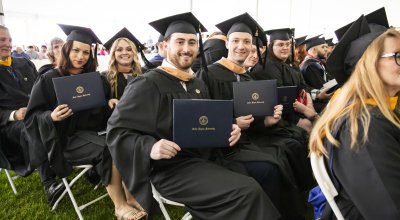
As Salve Regina University conferred 204 master's degrees, 25 doctoral degrees and five Doctor of Nursing Practice degrees during graduate Commencement, the afternoon became a celebration of academic achievement, but also of resilience and purpose-driven leadership.
Cara O'Donnell '26 (M) captured that spirit in a keynote address that resonated deeply with her Class of 2026 – a class made up of working professionals, caregivers, researchers, health care leaders and lifelong learners whose journeys to Commencement looked vastly different, yet shared a common thread of perseverance.
"When we picture a moment like this, we often imagine a clear path that led us here," O'Donnell told graduates gathered in the tent on the oceanside campus. "But for many of us, that is not what this journey looked like."
O'Donnell, who completed her master's degree in healthcare administration along with a graduate certificate in healthcare leadership, also works within the Mass General Brigham Health System. Drawing from both personal hardship and professional experience, she reflected on the quiet strength that defines so many graduate students' lives.
"There was a season in my life where everything I thought was certain, shifted," she said. "I remember sitting at my laptop after a long day of work, staring at an assignment that felt impossible."
Her words acknowledged the realities many graduates faced while earning their degrees – balancing coursework with careers, parenting, healing and personal challenges that often remain unseen.
Nationally, earning an advanced degree remains a significant achievement. According to U.S. Census data, only about 14% of Americans hold a master's degree, while roughly 2% hold a doctoral degree – making the graduates recognized at Salve's ceremony part of a small group of individuals who have pursued education at the highest levels.
"Every person here has overcome something to sit here today," O'Donnell said. "And that is what makes this moment so meaningful."
That message echoed the University's mercy mission and the values at the heart of graduate education at Salve – compassion, ethical leadership and service to others. O'Donnell emphasized that mercy is not only something extended outward, but also inward, particularly during moments of uncertainty and change.
"At Salve Regina University, we are not just taught how to succeed," she said. "We are taught how to live with mercy. And mercy is not only something we extend to others. It is something we must learn to give ourselves."
30 doctoral degrees reflect diverse fields grounded in shared values
The ceremony also highlighted the breadth of Salve's graduate and doctoral programs. The University awarded doctoral degrees across four areas of study: the Ph.D. in humanities and technology, the Doctor of Nursing Practice, the Ph.D. in behavior analysis and the Ph.D. in international relations.
Each program reflects Salve's interdisciplinary and mission-driven approach to education. The Ph.D. in humanities and technology challenges students to examine the human experience through ethical reflection and civic engagement. The DNP prepares nursing professionals to lead health care systems with compassion and innovation. The Ph.D. in international relations equips graduates to study global affairs through immersive, culture-driven research, while the Ph.D. in behavior analysis emphasizes transformative education, research productivity and compassionate mercy leadership rooted in dignity and respect for all.
Throughout the ceremony, graduates were reminded that their education was never solely about earning a credential, but about becoming leaders capable of navigating complexity with empathy and humanity.
"You are not behind. You are not late. You are not off track," O'Donnell told her fellow classmates. "You are exactly where your path has led you to be."
As graduates crossed the Commencement stage, the ceremony reflected a defining characteristic of Salve's graduate community: students arriving from different backgrounds and life stages, united by a shared commitment.
"As we leave here today," O'Donnell said in closing, "do not just carry forward your degree. Carry forward your story, your resilience and your compassion. Because the world does not need a perfect version of you. It needs a real one. A resilient one. A deeply human one."
The doctoral recipients and their dissertation titles were:
Behavior analysis
- Hannah Christine Grey: "Examining Effects of Fidelity Error Sequence during Differential Reinforcement of Alternative Behavior"
Humanities and technology
- Jennifer Ann Bates Ehlert: "The Matinee Girl: Art, Theater, and Classicism in Nineteenth-Century London"
- Elizabeth K. Battaglia: "The Legacy of the Feminine Ghostly Tales Tradition in the Novels of Wendy Webb"
- Amy M. Beaudry: "Securing the Safety Pin’s Role in American Industrial History: A Study of This Object and the People Attached to It"
- Aybuke Bilgin: "The Impacts of Intimate Partner Violence on Turkish Women’s Personal Security"
- Christina Agueda De Vreeze-Cabrera: "A Redefined Concept of Aesthetics for the Museum: The Pluriverse within the Museum"
- Jessica Marie Geren: "Guiding Lights: Exploring the Ethical Compass of Contemporary Doula Practices in the United States"
- Nicole Halloran: "Using Philosophy’s Wheels to Drive AI: Creating Synergy to Keep the Human in Human Resources"
- Matthew Jonathan Longcore: "Dreaming Spires: Collegiate Gothic Architecture on American Campuses"
- Judy T. Malana: "Victory of the Graveyard: Bernard Fall and the Second Indochina War"
- Patricia Saint Aubin: "The American Enlightenment and the Providence Library Company: A Social History in Five Books, 1753 to 1770"
- Russell Suereth: "Reclaiming a Participation: Our Everyday Experiences of Art, Sacredness, and Creativity"
- Michael Thurston: "The John L. Roper Lumber Company: How Canals, Lumber Towns, and Railroads Changed the Tidewater Landscape, 1850-1900"
- Donna Witters Banks: "A Peaceable World: The Blazing World of Margaret Cavendish and the Foundations of the Feminist Utopian Imaginary"
International relations
- Danielle M. Boulay: "Does Soft Power Work? Evaluating the Effectiveness of China’s Confucius Institutes in Latin America"
- Matthew Glen Butler: "Grand Security: The Nature and Character of U.S. Grand Strategy"
- Stephen Jay Dorff: "The Role of Russian Nationalism in the Invasion of Ukraine"
- Antonio Alexander Fontana: "Italian National Identity since the Risorgimento: A Discursive and Historiographical Analysis"
- Michael Grzybowski: "Policy, Passion, and Probability: Coalition Warfare and Path Dependence in Afghanistan"
- Keenan Anthony Harris: "Taiwanese Silicon Shield: A Historical and Empirial Review with Analysis of U.S. Dependence on Taiwan Semiconductors and Probabilistic Risk Analysis of a U.S. Sino Deterrence Failure"
- Dory Leigh Hasson: "Ireland at a Crossroads: The Path to Peaceful Unification in a Post-Brexit Era"
- Jacob F. Nelsen: "Balance of Power Competition Reimagined in the Digital Age: An Analysis of U.S. Security Sector Assistance Across the African Sahel"
- Jason Schoch: "No Fate But What We Make: Structured Divergence in the Artificial Intelligence Governance Approaches of the U.S., EU, and PRC from 2016-2024"
- Martina A. Sprague: "National Security and Statecraft: A Case Study of Sweden’s Political Discourse Surrounding the Civilian-Military Geostrategic Nexus and the Application for Membership in NATO"
- David Toler: "When the Past is Present: The International Relations Impacts of Cultural Artifact Repatriation Decisions"
Doctor of Nursing Practice
- Kelly A. Cruise: "Enhancing Preadmission Communication of Postictal Agitation Risk in the Epilepsy Monitoring Unit: A Retrospective Quality Review"
- Jennifer Hoey: "Comparing Loneliness Assessment Tools in a Veteran’s Community"
- Ashley E. Pastor: "Interactive Shoulder Dystocia Simulation Training Impact on Staff Safety Attitudes and Preparedness"
- Dilys Poku-Mensah: "Implementing the GAD-7 Tool in Primary Care for Improved Detection of Generalized Anxiety Disorder"
- Ann Marie Van Hof Starry: "Evaluating the Effects of a Tutorial on Usage of Digital Psychosocial Supports in Young Adults with Acute Leukemia"