Trump is undercutting world order launched after WWII, history professor says
On the Rhode Island Report podcast, Salve Regina University professor Jim Ludes talks about US foreign policy on Greenland, Venezuela, and Canada.
By Edward Fitzpatrick, The Boston Globe
After World War II, the United States built an international system that established rules for how countries deal with each other, and that helped to build US wealth and power, Salve Regina University history professor and vice president Jim Ludes said.
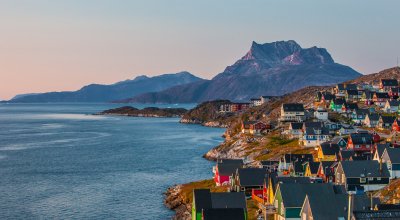
But the Trump administration is undercutting that world order with actions such as the capture of Venezuelan President Nicolás Maduro and Trump’s push to take control of Greenland, Ludes said on the Rhode Island Report podcast.
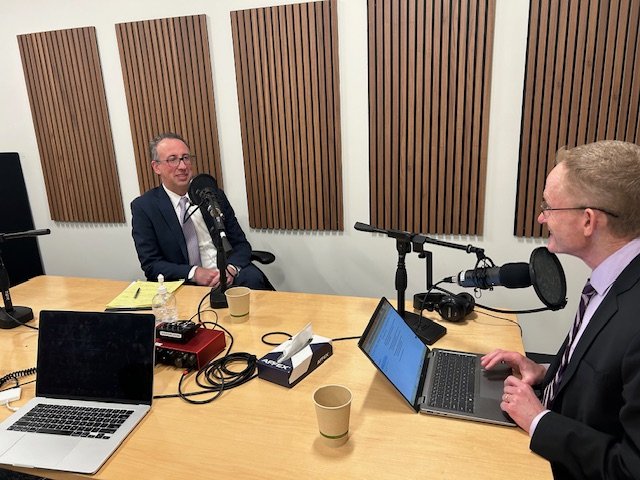
Ludes, executive director of Salve’s Pell Center for International Relations and Public Policy and vice president for strategic initiatives, said the international system was formed on the idea that nations would not use force to expand their territory.
But at one point, Trump said he was not ruling out the use of military force to seize control of Greenland, a semi-autonomous territory of Denmark, although he later backed off that threat.
“I think it’s difficult to overstate how outside the norm of the behavior that you would expect from an American president that this actually is,” Ludes said. “The damage that this has done to America’s relationship with Europe is profound. We’ve heard privately from European diplomats, and some in public, that they will not trust the United States again, period.”
While the old world order is not gone for good, he said the relationship between the US and Europe is facing "a real crisis."
“There’s tremendous strain on the international system, and it’s not just because of Donald Trump,” Ludes said. “Different states are recognizing in this moment an opportunity to assert geopolitical influence in a way that we haven’t talked about since the worst days of the Cold War and maybe even before the Second World War.”
After Russia invaded Ukraine in 2022, Finland and Sweden joined NATO, he noted. “This is no small feat,” he said. “In the long history of NATO, the Nordic countries maintained a certain level of independence.”
And now European countries such as Sweden, Norway, Germany, and the Netherlands are talking about developing their own nuclear deterrent because they’ve concluded they can no longer rely on the US nuclear deterrent, Ludes said.
Among European nations, only the United Kingdom and France have their own nuclear arsenals, although five other countries host US nuclear weapons.
Ludes said the prospect of nuclear proliferation is prompting a “raging debate” in academia about whether having more countries with nuclear weapons would be good or bad.
“I’m a little bit old school,” he said. “I think more nuclear weapons is bad. If we’re talking about expanding the number of countries that have access to that technology, you’re also expanding the complexities of deterrent relationships.”
At the same time, President Trump is slashing the amount of US funding for international humanitarian assistance and international broadcasting, although those are “two elements of soft power that have been traditionally a real asset in America’s arsenal,” Ludes said.
Charities have been unable to fill the void left by cuts to US humanitarian aid, he said. And China and Russia are filling the void in international broadcasting in places such as Africa, South America, and South Asia, hurting US attempts to win “hearts and minds” across the globe, he said.
Meanwhile, Trump has threatened to slap a 100 percent tariff on goods imported from Canada if America’s northern neighbor goes ahead with a China trade deal, and Trump has taken to calling Prime Minister Mark Carney “Governor Carney,” highlighting Trump’s call for making Canada the 51st state.
Ludes noted the United States and Canada have a long history of peaceful relations, and tremendous economic integration. But Trump “has a different view of international relations than most of his predecessors,” he said.
While William H. Seward, President Abraham Lincoln’s secretary of state, believed that “diplomacy is to do and say the nastiest things in the nicest ways,” Ludes said, “President Trump forgot about the nicest ways part.”
“Canadians are the nicest people on the planet, and when we start talking about rising Canadian nationalism because of a provocation by an American president, my own personal opinion is that somebody’s made some fundamental miscalculation here,” Ludes said. “This is not necessarily a fight that’s in anybody’s interest.”
The Rhode Island Report podcast is produced by The Boston Globe Rhode Island with support from Salve Regina University. To get the latest episode each week, follow the Rhode Island Report podcast on Apple Podcasts, Spotify, and other podcasting platforms, or listen here.
Feature Image by Getty Images/KimKimsenphot