Salve Ph.D. student conducts research at the Vatican, meets Pope Leo XIV
Through rare access to Vatican archives, Michael Deel '23 (M) investigates how the Church navigates diplomacy with authoritarian governments.
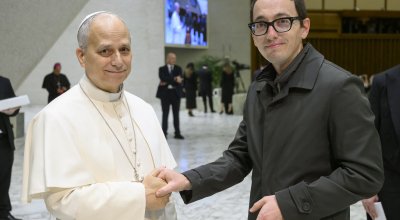
For Michael Deel '23 (M), a doctoral student in Salve Regina University's Ph.D. program in international relations (IR), research has taken him far beyond the classroom – all the way to the Vatican archives in Rome and into a private audience with Pope Leo XIV.
The moment marked a once-in-a-lifetime highlight in Deel's doctoral journey, but it also underscored the real-world stakes of his research: understanding how diplomacy can protect vulnerable communities living under authoritarian regimes.
A diplomatic dilemma
The Vatican has long grappled with this challenge. When it signs agreements with authoritarian governments, critics argue it risks legitimizing those regimes.
"If the Vatican signs agreements with dictators, critics say it’s giving them legitimacy," Deel explained. "But if it refuses to talk at all, ordinary Catholics, priests, nuns and families can be left completely exposed with no protection whatsoever."
Deel's research, drawn from archival work at the Vatican, sheds new light on how the Church has historically navigated that dilemma.
While examining documents from 1933, Deel discovered private memos revealing that Pope Pius XI approached the Vatican's concordat with Nazi Germany in a way historians had largely overlooked.
"He didn't see it as a surrender," Deel said. "He deliberately built in 'escape clauses.' There were clear conditions. If the Nazis broke the deal, the Vatican planned to publicly call them out."
And that moment arrived in 1937 with the encyclical book (a letter to the faithful) "Mit brennender Sorge," written by Pope Pius XI, which openly condemned the Nazi regime.
Deel calls this framework emerging from his research "conditional concordats."
The idea is straightforward but powerful: conditional concordats are agreements that allow diplomatic engagement while establishing measurable human rights "red lines." If those conditions are violated, the Vatican reserves the right to publicly condemn the offending government.
"Realists say you just cut deals with whoever is in charge," Deel said. "dealists say you should never compromise. My work shows that religious actors like the Vatican can strategically use moral leverage, turning diplomacy into a tool that protects people without selling out their principles."
His research applies this concept to several contemporary geopolitical challenges, including the Vatican's ongoing relationship with China following the 2018 agreement on bishop appointments, the role of Catholic communities in Russia amid the war in Ukraine and the fragile political transition in Syria after the fall of the Assad regime in 2024.
From an international relations perspective, Deel argues that religious institutions can wield a unique form of diplomatic influence.
A memorable audience with Pope Leo XIV
Deel's archival research also opened doors that few scholars experience.
Through contacts he developed while working in the Vatican archives, Deel was granted a private audience with Pope Leo XIV in Rome. During their meeting, he shared the central ideas behind his research and how they build on the diplomatic approach of Pope Pius XI.
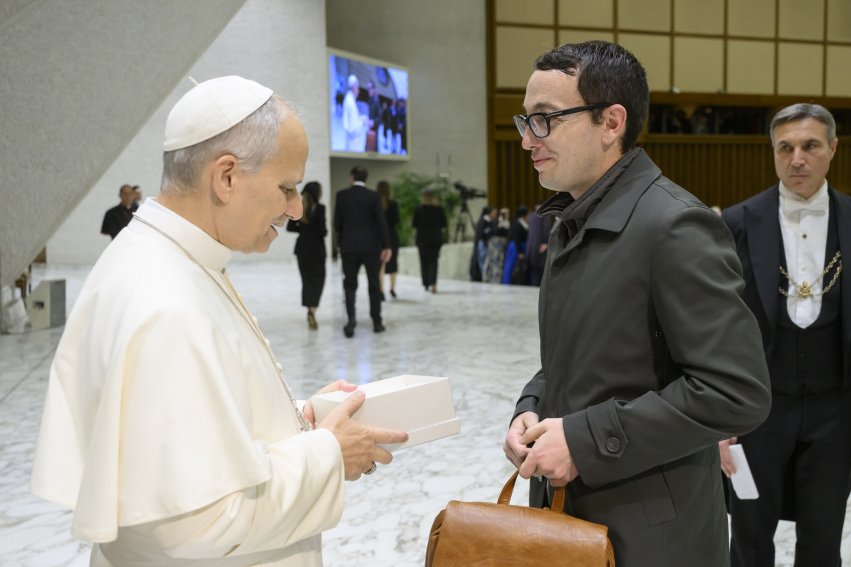
"I was able to tell him directly about my research on conditional concordats," Deel said. "We spoke briefly about protecting Catholics in difficult places today, and we exchanged small gifts."
For a scholar studying Vatican diplomacy, the opportunity to discuss those ideas directly with the pope felt especially significant.
"It was an incredibly meaningful moment," he added.
Research shaped by Salve's approach
For Deel, pursuing this work at Salve has been essential in shaping the interdisciplinary approach behind his research.
"I chose Salve's IR Ph.D. program because it combines rigorous international relations theory with a strong Catholic intellectual tradition, something I hadn't found elsewhere," shared Deel. "After completing my master's here with great professors and a supportive environment, it felt like the natural next step."
The program's emphasis on ethics alongside global politics helped him frame the Vatican not only as a moral authority but also as a strategic diplomatic actor.
"Salve's program has given me a strong grounding in both realist and constructivist IR theory, which helped me frame the Vatican as a strategic actor, capable of using norms and moral leverage in asymmetric diplomacy," he said.
Faculty mentorship has also been influential – particularly from professor Dr. Chad Raymond, associate graduate director of criminal justice and cybersecurity.
"His classes sharpened my ability to analyze how institutions and moral principles operate under pressure, which directly informs my work on conditional diplomacy," Deel said.
As Deel continues developing his dissertation, his research suggests that the Vatican's historical diplomatic strategies may offer lessons for policymakers today.
"It's a practical idea that could help not just the Vatican, but any country or organization trying to do good in dangerous places without becoming complicit in the bad stuff," he said.
For Deel, the journey from graduate seminars in Newport to the archives of the Vatican – and a conversation with the pope himself – reflects the power of research grounded in both intellectual rigor and ethical purpose.
And in the complex world of international diplomacy today, those perspectives may prove more relevant than ever.