
Creating a new narrative for theatre: Theatre as vocation
Salve Regina University assistant professor explores a different way of thinking about the utility of a theatre arts degree.

This article was originally published on Vocation Matters, the blog of the Network for Vocation in Undergraduate Education (NetVUE), Dec. 4, 2025. NetVUE is a program of the Council of Independent Colleges.
By Dr. Tara Brooke Watkins
Lights up on theatre professor’s office. STUDENT sits across from PROFESSOR, tears running down their cheeks. PROFESSOR is used to this, has multiple tissue boxes around.
STUDENT: All I’ve ever wanted to do is theatre. But my parents said they’ll disown me if I major in it.
PROFESSOR: Why are they against it?
STUDENT: They say I won’t get a job; I’ll be poor. They think it’s not a real career; it’s just a hobby. They don’t take it seriously.
PROFESSOR offers tissue box as scene fades to black.
This scene is a common one in my life as a faculty member in theatre. When it’s not a lack of parental support causing a student pain, it’s a college admissions officer’s low opinion or a peer’s slandering comment. What leads the world to suppress someone’s call to a career in the arts? What assumptions lead to myths that a theatre degree is “worthless?”
In these scenarios, three influential beliefs are at play: theatre is limited to productions, it’s not a financially viable career, and it is not “serious.” As Christine M. Fletcher acknowledges, academics face pressure to justify the costs of a college education if it doesn’t lead to a well-paying job. This kind of cultural context is what William T. Cavanaugh asks us to observe as we attend to how people, especially our students, discern their vocations. Both scholars point to the expectation in our American capitalist system that investment in a college degree yields a high financial return. This context demands proof from theatre programs that our degrees are worth it financially.
The language of vocation has altered my approach to this repeated scenario. Theatre is a vocation. Theatre students are deeply aware of the heart-ticking experience of an inner call. What many don’t experience is support from others in the academy and their family, voices from what David Cunningham describes as their outer network of concern. Given these negative messages and a life that demands resilience, theatre artists’ hearts must tick loudly enough to keep them moving forward. Their sense of calling compels them to navigate the idiosyncrasies of life in the theatre—and yes, there are numerous pathways to use a theatre degree and pursue this vocation.
If we follow Buechner’s definition of vocation, then theatre is inherently a gift to others. It is collaborative and vulnerable—it is for others, and therefore, meets a need. I have found the lens of vocation to be a great way to communicate our powerful work as the gift it is. Doing so starts by debunking myths.
Myth #1: Being a theatre artist just means putting on a show
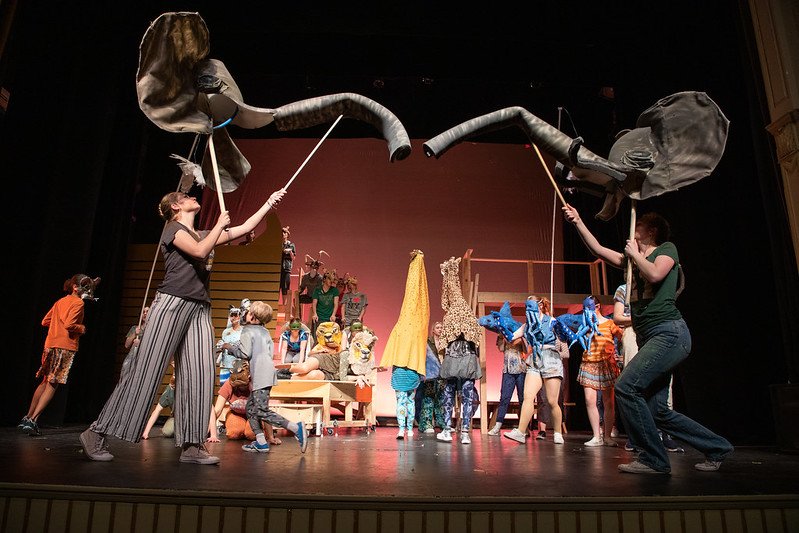
Productions are just one of a plethora of things theatre artists do. Since many onlookers don’t know this, the first step for us as scholars and practitioners is to explain the abundance of employment opportunities in the traditional theatre world. As we promote our degrees, we must communicate that training means marketability and skills in acting, dancing, singing, directing, designing (costumes, hair, makeup, set, lights, props, sound), carpentry, scenic painting, stage management, crew, playwriting, box office management, house management, sound engineering, production management and graphic design. Beyond the stage, it includes dramaturgy, arts administration, education, theatre education, social media management, business administration, event planning, hospitality, social work, ministry, counseling and public speaking. I have watched students get jobs in these areas because of the added value of their creative arts background. Theatre is more than performance; it is a foundational training ground in many areas.
To be clear, those who “just” put on a show are also gifts to the world and work diligently at their craft. The fear of a theatre-based career being “unserious” may come from watching actors ostensibly having fun on stage. They are called “players,” after all. And when one play ends, there is no guarantee of casting or crewing consecutive productions, prompting some to observe that all theatre artists are “gigging it”—always hustling to find a new temporary job as the former one ends. The new job might be a box office assistant while the former one was as an actor or a light board operator. When the traditional standard of workplace success assumes a ladder-based trajectory in a no-end-date job, gig life unsettles onlookers—especially parents. It communicates instability, playing around and frivolity.
Yet theatre artists who pursue gig life often do so within the field of theatre, and therefore, demonstrate consistency and develop a professional network. What appears like bouncing around or changing jobs is evidence of persistence and marketability as they build their resumes with various skills. When theatre professionals “bounce around,” it’s not frivolity or job insecurity; it confirms their employability.
Myth #2: So few “make it,” there’s no point wasting your time
This myth presupposes many things, but the one assumption I want to challenge is that a theatre degree is solely training for a trade, meant only to teach those who want to “make it” in theatre. In actuality, it is a humanities degree that teaches life skills using theatrical means. For those who are uncertain about their calling, theatre can serve as a context in which to explore that calling, as well as possible careers:
- Theatre studies is the practice of engaging with people different from us and learning empathy and understanding.
- Dramatic literature is a window into cultures, history and lived experiences.
- Creative play helps people in communities speak what cannot be put into words.
- Technical skills teach collaboration, leadership and organization.
- Performing builds self-confidence and public speaking and communication skills; it develops healthy risk-taking and safe vulnerability.
For students who need to build self-confidence after the world has sent them messages that diminish their self-worth, theatre empowers them to be a listener, an observer, an empathizer and a giver; a risk-taker, a creative problem solver, an action-taker and a leader; a team player, an organizer, a time-manager, a critical thinker—and a student of philosophy, religion, history, culture and humanity. Ultimately, no matter how one engages in theatre, it helps someone feel less alone in the world.
Myth #3: You won’t make money
Actually, you will. People get paid to do this work. It is a common misconception that theatre makers do it solely for passion and fun, not pay. Professional actors, tech crews, designers, directors and managers often belong to unions who ensure they get paid their worth. Those who do not, or don’t vie for performance opportunities, still find jobs in theatre companies and other related organizations because they have a theatre degree.
A cycle has been perpetuated that devalues us as theatre makers because we accept less than our worth. Many of us are used to being on the bottom rung of a ladder when receiving resources we need to succeed. We develop a “take what you can get” mentality, which conveys that there is little money in the craft. As faculty members, we too often model to students that their theatre degree will be considered of lesser value. We need to celebrate theatre artists for who they are and what they do for the world. We need to teach theatre students how to tell the story of their value in a job interview. We need to show the academy and our campuses the value of theatre so that the outer network of concern in turn values the craft and our students’ vocations.
I can’t change the cultural context in which people approach vocational decision-making. What I can change is how I tell the narrative of what amazing people theatre artists are. We are an art form that has persisted and adapted over millennia. We bring strangers together and connect them through tears and laughter. We empower people and ourselves, modeling bravery and risk-taking. Society needs theatre artists, and the academy is the perfect place to foster them.

Dr. Tara Brooke Watkins is a story circle facilitator and community engagement specialist with an emphasis on creating dialogue, action and communal healing around charged topics like race, gender, gender identity, body image, sexual victimization and homelessness. This work often leads to theatrical productions using communal stories, including plays "The Bible Women’s Project," "Tulsa ’21: Black Wall Street," "The Father Bill’s Play," "Shatter the Silence" and an upcoming campus production about the impact of social media on college communities. At Salve, she is the chair of the Mercy Culture Commission, which seeks to create a welcoming environment for all students, staff and faculty. She was a participant in the 2025 NetVUE Seminar, Enhancing Vocational Exploration.