
Can AI predict the next breakout NHL star?
Carolyn T. Stirling '26 explores how machine learning and performance data intersect, bringing her passion for hockey and analytics to the SRyou Student Exposition.
By student writer Faith Lam '27
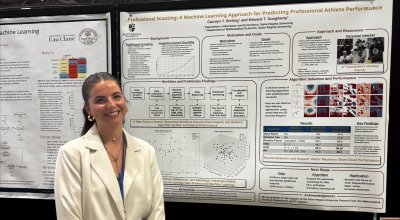
Carolyn T. Stirling '26, a business administration major, is preparing to present her research "AI in Sports: How Machine Learning can be used to Predict Athletic Performance" at Salve Regina University's annual SRyou Student Exposition on Wednesday, March 25.
As a member of the University's women's hockey team and a lifelong player of the game, Stirling has been able to combine her love of the sport with the education she has gained in the last four years – using research data and stats to help predict athlete performance in the NHL.
Stirling's family has a long legacy in hockey. Her grandfather, Steve Stirling, is the former head coach for the New York Islanders and still works as a scout for the Ottawa Senators in the NHL, and both her parents played Division 1 hockey.
Stirling is proud to share her research and hard work with the Salve community and is passionate about continuing her work in the future.
Q: Can you introduce your project for the SRyou Student Exposition?
A: Within the sports world, data analytics and statistics are starting to have a more prominent presence in how players, teams and all areas of sports are evaluated, and especially within hockey. It's really starting to take off and a lot of advancements are starting to be made. I set out to find an artificially intelligent data analytical approach to predicting professional athlete performance.
With our focus being on hockey, we took data from players who are competing in college now and compared it with current players in the NHL who were drafted out of college. We put that all into a data set and tested a series of different algorithms to find the best results, in order to predict the success rates of current college players and how well they'll do in the NHL.
Q: What was your inspiration/motivation in researching the use of machine learning to predict athletic performance?
A: Hockey is a huge part of my life, and I plan on continuing my professional career within the sport once I graduate. I have enjoyed learning about data analytics and statistics as well as sports scouting, so I wanted to find a way to combine those into a research project. After taking data analysis and visualization with Dr. Dougherty [associate professor of mathematics], I began working with him to drive this project forwards.
Q: Can you discuss the key milestones in the development of your project?
A: Once we identified our goals and motivations, we began collecting data and inputting it into an Excel file. It took a lot of hard work to sort through everything we had collected and put it into different algorithms. We tried various versions of algorithmic codes to find the best results with the data we collected. Now, we have had high success with our data set, even though it was small, but I hope to keep working towards better and higher results.
Q: What obstacles have you had to face while conducting this research?
A: The majority of the challenges I ran into were related to finding proper and accurate data, because the NHL has only been using modern statistics collectors for the last decade, so that narrowed the amount of accurate information available on a majority of players. There were times when we had to scratch and restart certain data through the codes when it wasn't working or there was more accurate data to be found. I overcame these challenges by diving even deeper into my research and discovering more methods to find the results we were in search of.
Q: What part of this project are you most proud of, and what are you most excited to share with the salve community?
A: At SRyou, I will be presenting a poster with all of my findings. I am excited to show Salve how data and statistics are interconnected with sports. It's definitely not something most people think about. In starting this project, I wanted to begin producing a need or want within professional sports. Being able to combine my passions of hockey and math/business has been fulfilling, so I hope it inspires people to do the same.
Q: How do you plan to continue with this project in the future?
A: This project isn't over yet. The data set is expanding constantly and there is so much more that can be done with it. Over the summer, I plan on finalizing the research and putting it into a research paper to be published with Dr. Dougherty. I hope to continue working on this and integrate it into my future career goals.
Having a chance to work with sports data and statistics has given me a new appreciation for coaching and scouting, and this experience will be a skill that will help achieve whatever goals I may have.
Q: How do you think this project aligns with the University's mercy mission?
A: Being a young woman in not only sports but also business – both primarily male-dominated fields – is not always easy. However, having had opportunities to follow my passions while at Salve and been encouraged to do so has been part of my own experience with the mercy mission. Salve has given me the platform and resources to be successful in my research, and pave the way for future female athletes who want to dive deeper into the analytical side of sports.