
For Alyssandra Anderson ’26, psychology and social work go hand in hand
Double majoring strengthened both conceptual understanding and practical application of each discipline.
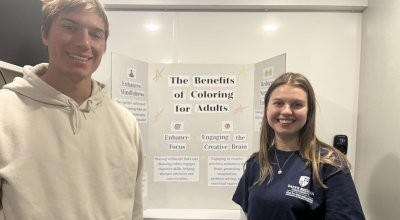
When Alyssandra Anderson ’26 arrived at Salve Regina University, she knew she wanted to study psychology. She also knew she wanted her learning to extend beyond the classroom. What began as a psychology major with a minor in human services soon evolved into a double major in psychology and social work – a combination that has shaped the way she understands people, systems and the work she hopes to do after graduation.
“I realized pretty quickly that psychology and social work go hand in hand,” Anderson said. “Psychology is broad, and social work is more specific. When you put them together, it really strengthens how you think about behavior and how you work with people.”
With guidance from faculty advisors, Anderson officially added social work as a second major during her sophomore year, carefully mapping out coursework that allowed both disciplines to complement one another.
Learning theory – and applying it
Anderson says the overlap between the two programs has helped her retain material more deeply and apply it more confidently, especially in hands-on settings.
“A lot of the theories align,” she said. “Having that psychology background makes social work concepts easier to understand and apply, especially when you’re working directly with people.”
That connection became even clearer after Anderson studied abroad in Italy, where she took a child psychology course in Reggio Emilia. Visiting local schools and daycare centers exposed her to a more creative, environment-based approach to childhood development –lessons she later drew upon in social work coursework and in practice.
“When I came back and took classes like human behavior, I was able to place those theories into real situations,” she said. “It made me more confident in the material.”
A defining feature of the social work major is its two years of field experience, compared to many programs that offer placements only in the senior year, which Anderson says have been instrumental in shaping her professional goals.
During her junior year, she completed a year-long placement with Looking Upwards in Middletown, Rhode Island, working with adults with intellectual and physical disabilities. She led group sessions on internet safety and worked one-on-one with clients, adapting language and activities to meet varying levels of understanding.
“You have to think carefully about how you communicate,” she said. “Psychology helped me understand how people process information, and social work helped me make sure everyone felt included.”
Now in her senior year, Anderson is completing her final placement with Tides Family Services, working in outreach and tracking across RI. Her role includes documenting client behavior, participating in daily team rundowns and conducting home visits with five to six clients each day – many of them teenagers.
“I love working with teens,” she said. “I feel like I can connect with them, and my coursework has really helped me learn how to communicate in ways that feel respectful and supportive.”
Support beyond the classroom
Balancing a double major can be demanding, but Anderson credits Salve’s class sizes and close faculty relationships for making it manageable.
“The social work program is small, and that makes a huge difference,” she said. “You get feedback quickly, and professors genuinely want to help you succeed.”
She is an active member and current co-chair of the social work honor society, participating in outreach initiatives like mobile health unit programming at the Salvation Army. These experiences, she said, have reinforced Salve’s mercy mission and the importance of service-oriented work.
“You’re not just learning theories,” Anderson said. “You’re putting them into practice.”
Through her coursework and placements, Anderson has clarified her post-graduate goals. She plans to pursue an accelerated master's degree in social work and is particularly interested in working with adolescents and individuals navigating substance use recovery.
“Field experience helped me figure out what I want to do and who I want to work with,” she said. “I feel prepared for graduate school because I’ve already had real responsibility in the field.”
For students considering a similar path, Anderson offers simple advice: talk with advisors early and don’t be afraid to advocate for what you want.
“Psychology and social work operate really well together,” she said. “The combination has given me a stronger foundation than either one on its own.”