
Faculty Fellows Spotlight: Dr. Patrick Campbell
Dr. Campbell offers a timely exploration of toxic political polarization, sharing practical ways individuals can guard themselves against division while creating spaces of belonging.
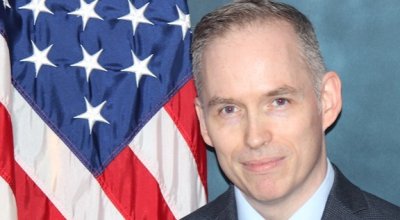
In the second installment of The Pell Center Faculty Fellows Spotlight Series, Dr. Patrick Campbell describes his research on toxic polarization and his practitioner approach to lessening our political divide. Campbell is director of the Center for Teaching and Learning, an affiliate assistant professor of political science and a Pell Center Faculty Fellow. A member of the Salve community for five years, he brings an infectious enthusiasm and a deep commitment to engaging across difference.
Q: What is your role at Salve and what are your areas of expertise?
A: I am the Director of the Center for Teaching and Learning, meaning I help faculty and staff become the best teachers they can be by connecting them with resources and new strategies. I also mentor junior faculty through their tenure process. Additionally, I am an affiliate assistant professor of political science. In this role, my areas of expertise are the American presidency, American political thought and, most particularly, political polarization.
Q: What questions are keeping you curious right now?
A: In both of my roles at Salve, I am engaging right now with the balance between maintaining a commitment to free speech and inquiry in academic settings and supporting a sense of belonging amongst our community members. It is a challenge, but one I think we can solve or at least find enough agreement on to move us forward.
Another issue I’m focused on is how we can—individually—reduce political polarization. On a large scale, I am not sure if we have the power to individually fix toxic polarization, but by giving people a model for inoculating themselves against the polarization virus, of reducing it themselves, I think we might at last make some good progress.
Q: Do you see an overlap between your research on political polarization and this question of creating a culture of free speech and inquiry balanced with belonging?
A: Absolutely. Everyone is affected by political polarization because it is a human condition. I think the only way we can reduce political polarization is by being able to freely inquire about the ideas we hold. When we engage in academic inquiry or free speech, we bring our biases into the conversation. None of us can perfectly examine our own thoughts and beliefs in order to reduce these biases, but honest, open discussion with others can help. If we are not continuously examining our beliefs and our reasoning, we make it harder to engage with others in that intellectually rigorous way.
None of us can perfectly examine our own thoughts and beliefs in order to reduce these biases, but honest, open discussion with others can help. If we are not continuously examining our beliefs and our reasoning, we make it harder to engage with others in that intellectually rigorous way.
Q: What can the individual do to reduce their own bias or personal sense of polarization?
A: I encourage others to listen to podcasts with opposing viewpoints, to read books from across the spectrum, and to widen their news sources. But that won't help unless we also do a second thing, which is very hard: be humble and enter the “public square” with humility. This is difficult because it means recognizing that we all hold simplistic or reductive views of at least some complex political topics. It’s hard work to ask yourself continually, "What am I missing here?" It helps to try to truly understand the arguments on the other side of the political spectrum and to vet information thoroughly.
Q: Is there something you’re especially proud of when you think about the work you’ve done at Salve?
A: I sometimes struggle with finding pride in my own work. I’m usually proud of the people and students here at Salve. After Charlie Kirk was assassinated, I tried to make space in the classroom for my students to honestly engage in a way that wouldn’t make them feel judged or attacked. I was so proud of their emotional and intellectual maturity. I was really inspired by them and by how they were able to understand that many things can be right at the same time, and that reality is often found in the grays.
I encourage others to listen to podcasts with opposing viewpoints, to read books from across the spectrum, and to widen their news sources. But that won't help unless we also do a second thing, which is very hard: be humble and enter the “public square” with humility.
Q: What's something you hope to gain from your work as a Faculty Fellow?
A: I'm looking forward to opportunities to collaborate with faculty, but I also hope to contribute to the success of The Pell Center. The impact of The Pell Center has been growing, and if I can contribute to the more effective execution of its mission, then I will feel like I've been a successful Faculty Fellow.
Q: What's one book, article, podcast or idea that has interested you recently?
A: “The Myth of the Left and Right: How the Political Spectrum Misleads and Harms America,” by Verlan Lewis and Hyrum Lewis, has given me so much to think about. It highlights the tribalism that creates an idea of a left and right, which is often a false dichotomy that divides us.
---
The Pell Center Faculty Spotlight Series features the dynamic expertise, teaching experience and community engagement of the Center’s Faculty Fellows. The Fellows represent a wide range of disciplines which intersect with the mission of the Center and the legacy of Senator Pell. Learn more about the Faculty Fellows.