

Faculty Fellows Spotlight: Dr. Mary Anderson
Anderson reflects on how her experiences connecting with community organizations has allowed her students to dive into the practices of civic education and engagement.
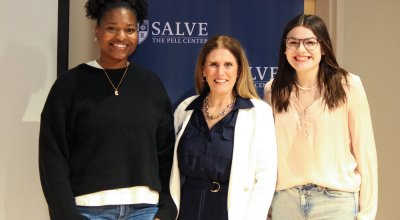
In this installment of The Pell Center Faculty Fellows Spotlight Series, Dr. Mary Anderson discusses her role leading civic engagement initiatives on Salve's campus, as well as her research on women in politics. A member of the Salve community since 2024, Anderson has made extensive efforts to further involve her students in the surrounding community.
Q: What is your role at Salve, and what are your areas of expertise?
I am the David and Carolyn Brodsky Chair in U.S. Constitutional Democracy and Culture, a professor of political science and the program director for the new public policy minor. I have a focus on American politics and public policy with a specialization in community and civic engagement and women in politics.
My previous studies on community identity and civic engagement feed my work in the classroom. I try to inspire students to understand that they’re part of a community, and that we all have responsibilities and obligations to that community.
My current research work is on women in politics and how we can empower women to engage in this system. I look at the role of first ladies, and how they are an inspiration to other women, but also important political actors who are not often given credit for the work that they do, which also applies to most women in politics.
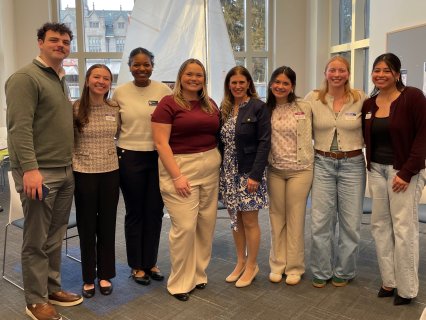
Q: What sparked your interest in community and civic engagement?
I'm a child of immigrants, and I remember my father taking me to the first U.S. election he voted in after becoming a citizen. I was very young and complained about the length of the line and the cold. He said to me, “This is very important. Not everybody in the world gets to do this.” That moment was really the start of my journey in this area, even though I was a small child and I didn’t really understand the depth of what it meant. But throughout my childhood, my family always talked about what was happening in the world and about our responsibilities as democratic citizens.
Q: What has your research on women in politics revealed to you about gender roles?
Common perceptions have women, especially women in politics and the first ladies, falling into the care work sphere. Women fill roles as the hostess, caretakers of the elderly and children, and as educators, whereas men take on the “hard” stuff. But that's not really true.
Oftentimes, the ask of women in the workplace goes above and beyond what their charge already is, and so it's not just that we have to encourage women to speak up and stand up for themselves, but we also need to encourage men to work in community with women to create spaces where all voices are heard and all contributions are valued.
Oftentimes, the ask of women in the workplace goes above and beyond what their charge already is, and so it's not just that we have to encourage women to speak up and stand up for themselves, but we also need to encourage men to work in community with women to create spaces where all voices are heard and all contributions are valued.
Q: What does community engagement look like at Salve as it relates to your work in the classroom or other academic projects?
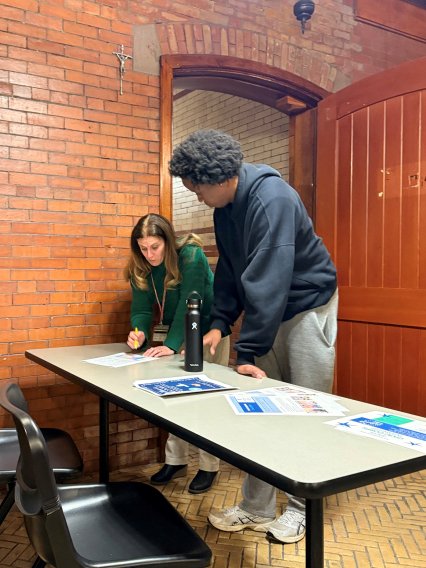
I’ve done lots of outreach to try to foster relationships with community partners, which has allowed me to bring folks from local, state, and national organizations into my classroom. In my class on public policy, we had about 10 guest speakers, and four of them were local community partners. This effort has let people in our community know that Salve is keen to embark on new projects by creating relationships that turn into potential opportunities for students to work with these community partners.
Q: What are some of the projects that you’ve been directing outside of the classroom?
The Civic LEAD program, which stands for leadership, engagement and democracy, is a broad program that encompasses several smaller projects. The Civic Lead Fellows, for example, are some of the most active students on Salve’s campus. They plan events and serve as mentors to students participating in the Rhode Island Civic Leadership Program hosted by the Rhode Island Secretary of State’s Office.
The next project is the Civic LEAD Research Scholars. These are students working in the research lab on projects related to what I study. One group is researching the policy role of first ladies, and the other is researching the current state of child marriage laws in the United States. The newest group is The Civic Leadership Lab, which is part of Salve’s Compass Summer program. These students are placed with community partners to work on a mission-driven, on-site project.
Q: What is something you hope to gain from your work as a Pell Center Faculty Fellow?
I hope to be able to share and learn from my colleagues. I hope to build a community of engaged scholars that are not just working in their individual silos but instead working in a multidisciplinary way to create a space to share ideas. I would like to see opportunities like faculty colloquiums or brown bag lunches, where the fellows can come together and say to their colleagues, “These are the things I’m thinking about or working on, can you guys help me through this?”
I hope to build a community of engaged scholars that are not just working in their individual silos but instead working in a multidisciplinary way to create a space to share ideas.
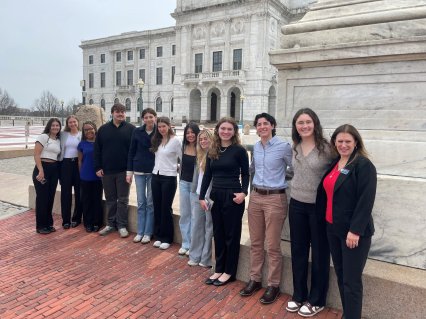
Q: What's one book, article, podcast, or idea that has interested you recently?
“Atmosphere” by Taylor Jenkins Reid. I'm only in the middle of it, but I’m already recommending it to people. It’s a novel about the first group of female astronauts accepted to the space program. It also tackles their challenges broadly and the hidden struggles members of the LGBTQ community endured during that time in that field. It touches on a lot of the elements of Salve’s mission, and it’s been a pretty inspiring book about overcoming crises and believing in yourself.
---
The Pell Center Faculty Spotlight Series features the dynamic expertise, teaching experience and community engagement of the Center’s Faculty Fellows. The Fellows represent a wide range of disciplines which intersect with the mission of the Center and the legacy of Senator Pell. Learn more about the Faculty Fellows.