
Faculty Fellows Spotlight: Dr. Jim Chace
Dr. Jim Chace stands out for his commitment to hands-on, experiential conservation education in this installment of the Pell Center Faculty Fellows Spotlight Series, which highlights the dynamic teaching, research, and community engagement of its Fellows.
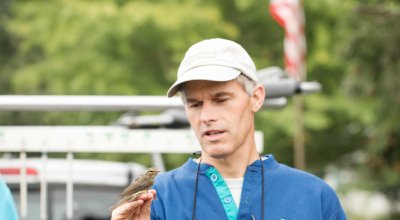
In the first installment of the Pell Center Faculty Fellows Spotlight Series, Dr. Jim Chace describes his work, teaching and contributions to the Salve Regina community. Chace is professor and chair of the Department of Cultural, Environmental and Global Studies and a Pell Center Faculty Fellow at Salve Regina University. An Aquidneck Island native, he has been a stalwart environmental activist on the island and a committed mentor on campus for over 20 years.
Q: What is your role at Salve and what are your areas of expertise?
A: I am a professor with joint appointments in the biology department and the cultural, environmental and global studies department, of which I am also the chair. I am also the faculty director of Community Engaged Learning.
My academic expertise is in ornithology, specifically avian ecology. I study the behavior and ecological interactions of birds, bird populations and bird communities, especially in how they respond to human-altered landscapes.
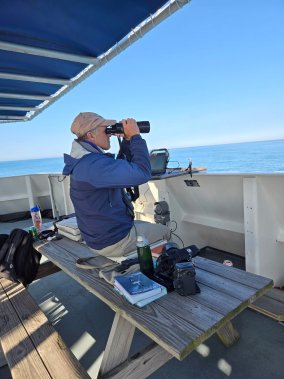
But at Salve, I lean into anything that is a local environmental problem where I can get students engaged in active learning and using science to solve problems. For example, we conduct water quality research at Almy Pond as part of the Aquidneck watershed study and the North East Water Resources Network, made possible by a RI-EPSCoR grant and in partnership with the Norman Bird Sanctuary. We also have a student-run hydroponic garden on campus and conduct research in avian ecology, like winter sea duck surveys.
At Salve, I lean into anything that is a local environmental problem where I can get students engaged in active learning and using science to solve problems.
Q: What first sparked your interest in the topics you study and teach?
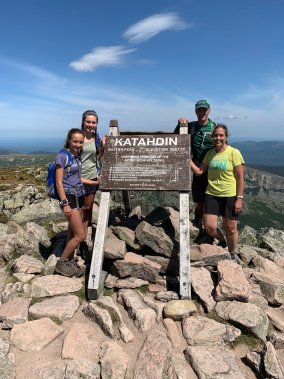
A: For as long as I can remember, I have been passionate about studying wildlife, being outdoors and identifying organisms. Even today, I find walking on trails boring compared to the slow, careful observant walks I take off trail.
Q: Is there a moment from the classroom—recent or memorable—that captures why you enjoy teaching at Salve?
A: I enjoy watching students take ownership of research projects and programs, like the hydroponic lab on campus. I get to step back to support and cheer them on. They ask the questions, find the methods, do the analysis and report the findings. Those are the best moments, and they happen every year at Salve.
I enjoy watching students take ownership of research projects and programs, like the hydroponic lab on campus. I get to step back to support and cheer them on.
Q: What questions are keeping you curious right now?
A: Right now, I am focused on conservation research and education. In partnership with the Norman Bird Sanctuary, I am developing research experiments framed by habitat restoration questions and working through how the results will inform habitat management, which in turn informs educational experiences. This education will bring new views and new people into the science and application process. What we learn through the experiments then informs a larger world where biodiversity is disappearing and we are racing against time and extinction rates as invasive species spread and native populations decay.
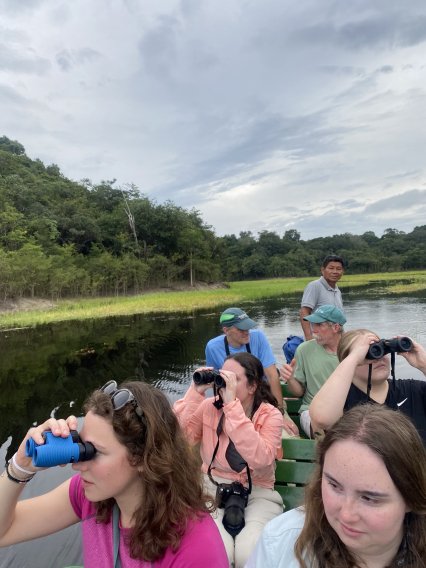
This work emerged from a conservation biology class I taught with a community engagement focus. It builds on increasing opportunities to bring students into the field for hands-on experiences.
Q: In what other ways do you connect with your community, whether that be in or outside of Salve?
A: I am involved in so many local organizations, mostly to help create opportunities for student engagement. I am a current board member of the Norman Bird Sanctuary and the Audubon Society of Rhode Island. For the latter, I recently helped establish and hire for a director of bird conservation role in the state. I have also been on the board of the Aquidneck Island Land Trust for almost a decade, am the former chair, and now sit on the advisory committee. I was a founding member of the Aquidneck Watershed Council and the Hunt River Watershed Council.
Professionally, I am the current chair of the Meeting Coordination Committee at the American Ornithological Society and a board member of the Ornithological Council. I am also the former president of both the Wilson Ornithological Society and the Ornithological Societies of North America.
Q: What is something you hope to gain from your work as a Pell Center Faculty Fellow?
A: I am looking forward to opportunities for team teaching across disciplines and collaborations on research; working together so we can inform each other’s work. I hope to create and develop timely programs that meet the needs of students today and fall within the shadow of Senator Pell.
I hope to create and develop timely programs that meet the needs of students today and fall within the shadow of Senator Pell.
Q: What’s one book, article, podcast or idea that has interested you recently?
A: Michael Shellenberger’s "Apocalypse Never," which is a cornucopia’s fever dream. It challenges my knowledge, assumptions and arguments about the environmental movement, green solutions and rationalizations. It’s like a second coming of Bjorn Lomborg and will die the same miserable academic death (with plenty of popular press supporting a lone wolf howling into the void), but I am learning a lot.
---
The Pell Center Faculty Spotlight Series features the dynamic expertise, teaching experience, and community engagement of the Center’s Faculty Fellows. The Fellows represent a wide range of disciplines which intersect with the mission of the Center and the legacy of Senator Pell. Learn more about the Faculty Fellows.