
Faculty Fellow Spotlight: Dr. Heather Rockwell
Dr. Rockwell offers reflections on how her experience with archaeology and preservation has allowed her to connect her students with hands-on learning opportunities, both within the Salve community and beyond.
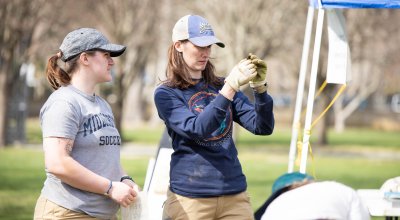
In the third installment of The Pell Center Faculty Fellows Spotlight Series, Dr. Heather Rockwell describes her research on archaeology and historic preservation, with a specific focus on North American Indigenous cultures. Rockwell is an assistant professor in the department of cultural, environmental and global studies and associate director of the Pell Honors Program. A member of the Salve community for six years, she encourages students to engage their curiosity through hands-on experiential learning and research.
Q: What is your role at Salve and what are your areas of expertise?
A: I'm an assistant professor in the department of cultural, environmental and global studies and I teach within both the sociology and anthropology and cultural and historic preservation programs. I also currently serve as the associate director of the Pell Honors Program. I'm an archaeologist by training, which is part of this broad discipline called anthropology, and my area of specialization is North American Indigenous cultures.
Before coming to Salve, I worked as the deputy state historic preservation officer for the state of Wyoming, focused on the regulatory and policy of archaeology.
Q: What sparked your interest in pursuing archaeology and preservation?
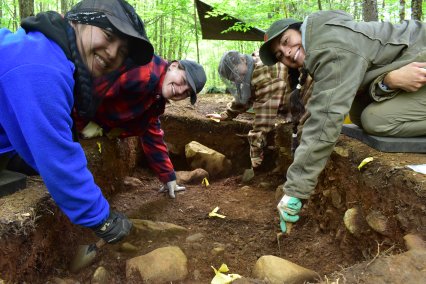
A: I've wanted to be an archaeologist since I was about eight. At first, I thought I wanted to be a marine biologist, but then I saw “Jaws.” When I was 16, I participated in an archaeological dig through a program hosted by the state of New Hampshire, and I was just absolutely hooked. I became fascinated with exploring colonization by North American Indigenous people. These are people coming to a completely empty space and saying, “Where do I want to go? How do I survive, and what kinds of choices do I make?” They were successful enough to create a population that, at the time of contact, may have been between 60 and 90 million people.
Q: What questions are keeping you curious right now?
A: There is a really hot debate in archaeology now about when exactly people arrived to the New World. It wasn't always such a contested topic of discussion. Prior to the 1980s, we were pretty sure that people got to North America around 13,000 years ago, at the earliest. Then there was a site discovered called Monte Verde in southern Chile that dates to about 14,500 years ago. It's in the very wrong location to be the earliest site we have in North America based on previous research, so the floodgates on this debate opened and even more sites dating further back have since been discovered. So, there is now this question of, are these sites and artifacts real or just wishful thinking?
I became fascinated with exploring colonization by North American Indigenous people. These are people coming to a completely empty space and saying, “Where do I want to go? How do I survive, and what kinds of choices do I make?”
Q: When a student enters one of your intro classes, what do you hope they take away from these discussions and lessons?
A: I want my students to get excited about things and to catch the curiosity bug. I know that they may not want to be an archaeologist, but I think being excited and interested is really important as you go through life, and I think being curious is essential to finding happiness.
I also want them to understand that the past is not a foreign country. People living 10,000 years ago had the same range of emotions and cognitive abilities as we do, they just valued different things. We are closer to these people than we realize, and by exploring their journey, we can learn more about ourselves.
Q: Are there any ways that you connect with your community through preservation work?
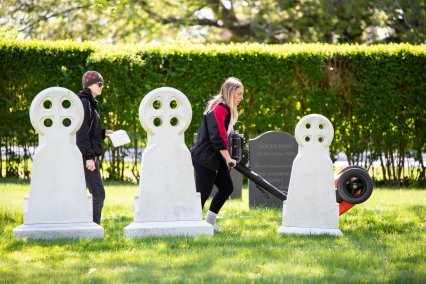
A: Our team at Salve works with a lot of partner organizations around town like the Newport Restoration Foundation, the Newport Preservation Society and the Newport Historical Society. Right now, we are working with the Wanton Lyman Hazard house, which is owned by the Newport Historical Society and soon to be a center for Black history. Salve has a significant portion of collections that come from excavation of the house, and students are currently examining the artifacts to better understand how people lived there. Many different families lived in the home, including slaves and servants.
We try to help these organizations as much as we can, and keeping a strong relationship with them has been beneficial to both our partners and our students.
People living 10,000 years ago had the same range of emotions and cognitive abilities as we do, they just valued different things. We are closer to these people than we realize, and by exploring their journey, we can learn more about ourselves.
Q: What's something you hope to gain from your work as a faculty fellow?
A: I'm hoping to work more closely with some of the other faculty members to see some of the fantastic research they’ve been completing. This will give me the chance to identify more opportunities for students to participate in research across the university. One of the great benefits of Salve’s smaller size is the chance for students to be closely mentored by faculty and actually have the chance to gain hands-on experience in research, even across departments.
Q: What's one book, article, podcast or idea that has interested you recently?
A: I have started reading a book called “Killing the Dead: Vampire Epidemics from Mesopotamia to the New World” by John Blair. This coming fall I will be teaching a course for the Pell Honors Program called “Origins of Horror.” I will be bringing the anthropological and archaeological side to the course, and Dr. Matthew Ramsey will be bridging this material with the film and literature tropes relating to fear of the unknown and fear of the supernatural across time and space.
---
The Pell Center Faculty Spotlight Series features the dynamic expertise, teaching experience and community engagement of the Center’s Faculty Fellows. The Fellows represent a wide range of disciplines which intersect with the mission of the Center and the legacy of Senator Pell. Learn more about the Faculty Fellows.