
Faculty Fellows Spotlight: Dr. Erin Redihan
Dr. Redihan reflects on how her dual interests in Cold War and Olympic history have shaped her research on how global superpowers use the Games to their advantage.
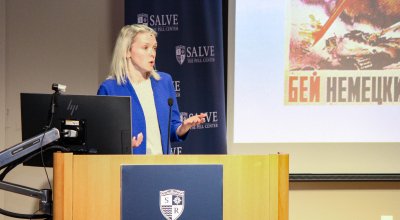
In this installment of the Pell Center Faculty Fellows Spotlight Series, Dr. Erin Redihan discusses her ongoing research on the intersection of Cold War power struggles and the Olympic Games. At Salve since 2015, Dr. Redihan encourages her students to recognize that no country operates in isolation
Q: What is your role at Salve and what are your areas of expertise?
I’m a lecturer in the history department, and I teach a wide range of courses, including the introductory survey in American history. My research examines how superpowers have attempted to manipulate sports—particularly the Olympics—especially during the Cold War era.
Q: What sparked your interest in studying the Soviet Union and its interaction with the Olympics, and how has your research evolved over time?
I’ve been interested in the Cold War since high school. I’ve always found it fascinating to study the Soviet Union—a country that no longer exists—because you can examine its entire lifespan from beginning to end.
I’ve been interested in the Cold War since high school. I’ve always found it fascinating to study the Soviet Union—a country that no longer exists—because you can examine its entire lifespan from beginning to end.
I also come from a family that watches a lot of sports, so I’ve long been interested in the Olympics. In graduate school, I began studying the Olympics from an academic perspective, which allowed me to combine these two interests.
I initially focused on how the United States, and the Soviet Union attempted to use the Olympic movement for political gain. Over time, my research has expanded to examine how activist groups tried to emulate these superpowers. For example, in the 1980s, a group advocating for Ukrainian independence recognized that an independent Olympic team could provide de facto recognition for their cause. While Ukraine did not achieve independence until 1991, their sophisticated public relations campaign helped draw international attention and pressured the Soviet Union to take their demands more seriously.
Q: What is the focus of your upcoming book?
My current book project explores how anti-Soviet protest groups leveraged the Olympic movement. I focus on three groups—Soviet Jewish activists, Baltic American activists, and Ukrainian American activists—and how they used media campaigns to highlight Soviet domestic policies throughout the twentieth century.
I’ve interviewed members of these groups, and many consider their efforts successful. Despite being relatively small organizations, they were able to gain international attention and build recognition for their causes.
Q: You teach a wide range of subjects—are there overarching themes you hope students take away?
A central theme across my courses is that no country operates in a vacuum. For example, when studying the United States in 1776, it’s essential to consider the roles of France and Britain. Similarly, in my “Modern Russia” course, we examine not only Russia itself but also its relationships with places like East Germany and the United States.
When we look at today’s geopolitical climate, these interconnected dynamics are even more apparent—reinforcing the idea that no nation is truly isolated.
Q: How do you connect with your community outside of teaching and scholarship?
I’m very involved in my local library community and am also a professional librarian. I worked in public libraries in Rhode Island and Massachusetts for nearly 20 years before joining Salve full-time.
I currently serve as a trustee at my local library and enjoy bringing my kids to their events. Libraries are incredibly important community spaces with great offerings, so I try to support my them as much as I can.
Q: What do you hope to gain from your work as a faculty fellow?
I’m excited about the opportunity to be a community scholar. The fellowship connects us with colleagues so we can exchange ideas and learn from each other. I hope the program continues to create space for fellows to share research, collaborate, and discover areas of overlap.
I’m excited about the opportunity to be a community scholar. The fellowship connects us with colleagues so we can exchange ideas and learn from each other. I hope the program continues to create space for fellows to share research, collaborate, and discover areas of overlap.
Q: What’s one book, article, podcast, or idea that has interested you recently?
This fall, I’m teaching a new Pell Honors Program course called “The 1980s: Conservatism, Christianity, and the Cold War,” so much of my recent work has focused on religion.
I recently reviewed “The Lives of Soviet Secret Agents” by Nadezhda Beliakova and Tatiana Vagramenko, which explores how the Soviet secret police used religious informers to monitor groups they viewed as problematic. I also read “Righting the American Dream: How the Media Mainstreamed Reagan’s Evangelical Vision” by Diane Winston. The book examines how Ronald Reagan—who was not especially religious and had been divorced—came to represent evangelical and family values in the 1980s.
I find it fascinating to study how people interpret religion and connect it to politics, and I’m looking forward to those conversations in class this fall.
The Pell Center Faculty Spotlight Series features the dynamic expertise, teaching experience and community engagement of the Center’s Faculty Fellows. The Fellows represent a wide range of disciplines which intersect with the mission of the Center and the legacy of Senator Pell. Learn more about the Faculty Fellows.